Power tools cover a broad range of product categories, technology types, and price tiers. This guide introduces some of the considerations for distributors approaching procurement and product selection decisions in wholesale power tools.
What Power Tool Categories Have the Highest Wholesale Demand?
Power tools are divided into functional categories based on their primary application. In wholesale markets, three categories consistently represent the largest share of transaction volume. A distributor building an initial range should prioritise these before expanding into specialised categories.
Drilling and Fastening
Drilling and fastening is the highest-volume category globally. It includes corded drills, cordless drills, impact drivers, impact wrenches, and hammer drills. Demand comes from construction, carpentry, automotive repair, and general maintenance — industries present in every market. Cordless drills are the single most purchased tool type in wholesale distribution.
The end-user industry a distributor targets determines which products within this category are relevant. A distributor supplying construction contractors will prioritise hammer drills and impact wrenches; one supplying furniture makers will focus on cordless drills and impact drivers.
Grinding and Finishing
Angle grinders cover both grinding and cutting disc applications in a single tool platform. This category is driven by metalworking, construction, and automotive bodywork. Angle grinders are among the most consistently sold tools across emerging markets in Southeast Asia, the Middle East, and Africa, where construction activity and metal fabrication generate sustained demand.
Cutting
The cutting category includes circular saws, jigsaws, and reciprocating saws. Construction and woodworking are the primary demand sources. Circular saws are essential on framing and carpentry job sites; reciprocating saws are standard in demolition and renovation work. This category is typically added to a wholesale range after drilling and grinding are established, as it requires a partially different buyer base.
How Is Technology Reshaping the Power Tool Market?
Power tools are produced in three technology configurations. Each occupies a different market position and carries different implications for product selection and pricing.
Corded Tools
Corded tools draw power directly from the mains. They deliver consistent output without battery management and carry lower price points than equivalent cordless models. Corded tools remain relevant in fixed workshop environments where mobility is not required and sustained power output matters. Their share of the overall market is declining as cordless tools improve in runtime and output.
Cordless Tools with Brushed Motors
Brushed motors use carbon brushes to transfer electrical current to the motor. This is an established technology with lower manufacturing cost. Brushed motors generate more heat than brushless equivalents and have a shorter operational lifespan under sustained use. They remain the dominant configuration in the entry and light-duty price segments, where price point is a primary buying criterion.
Cordless Tools with Brushless Motors
Brushless motors eliminate physical contact between the brush and commutator, reducing friction, heat, and wear. The result is longer tool life, higher efficiency, and greater power output relative to battery size. Brushless tools carry a 20–40% price premium over brushed equivalents in the same power class and are increasingly the standard expectation in the professional segment. The market is shifting from brushed toward brushless in the mid-tier segment, a transition that is most advanced in developed markets and accelerating in Southeast Asia, the Middle East, and Latin America.
Voltage Platforms and Battery Compatibility
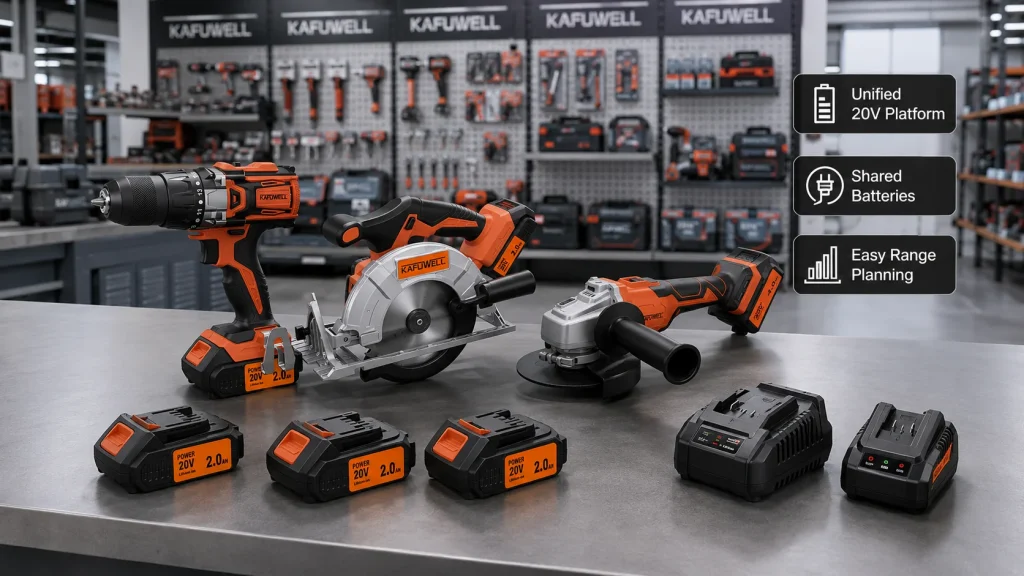
The voltage rating of the battery determines the power class of the tool. Mainstream cordless tools operate on 18V or 20V platforms — these are functionally equivalent, the difference being a measurement convention between manufacturers. Compact tools use 12V batteries; heavy-duty tools use 40V and above.
When a product range shares a single voltage platform, buyers can use one battery across multiple tools. This creates platform loyalty and influences repeat purchases. A distributor carrying tools across multiple voltage platforms creates battery fragmentation — buyers cannot share batteries between products, which complicates the purchase decision and increases after-sales complexity. Selecting one primary platform and building the cordless range around it produces a more coherent offering.
What Are the Three Power Tool Product Tiers?
Power tools are segmented into three commercial tiers. Tier selection determines which channels a distributor can access, the margin structure available, and the after-sales infrastructure required.
| Tier | Typical Buyer | Primary Channel | Use Pattern |
| DIY grade | Homeowners, weekend users | Retail, e-commerce, general hardware | Occasional |
| Light duty | Small contractors, tradespeople | Hardware wholesale, regional distributors | Regular professional |
| Professional grade | Industrial buyers, specialist contractors | Trade supply, direct procurement | Daily sustained |
DIY grade tools are built for occasional home use at the lowest price points in the category. Quality expectations focus on basic functionality rather than durability under sustained operation.
Light duty tools are built for regular professional use by small contractors and tradespeople. Motor specifications, component durability, and duty cycles are higher than DIY grade. This tier represents the largest segment by volume in most emerging markets. The majority of first-time wholesale distributors start here — market volume is larger than professional grade, and after-sales complexity is lower than the scale of DIY sales would require.
Professional grade tools are engineered for daily sustained operation in demanding environments. Motor specifications, housing materials, and component tolerances are substantially higher. After-sales expectations are correspondingly more demanding: defined warranty periods, accessible spare parts, and documented service procedures are requirements, not differentiators. A distributor without the capacity to support these commitments should not enter this tier regardless of the margin potential.
What Certifications Do Power Tools Need to Enter Major Markets?
Power tools sold in most markets require product certification before they can legally be imported and sold. A distributor must confirm that products hold the relevant certification for the target market before placing a purchase order.
| Market | Required Certification | Key Requirement |
| European Union | CE | Mandatory; accepted in Philippines and Vietnam as supporting documentation |
| Thailand | TISI | Factory audit reports and product test results required |
| Malaysia | SIRIM | Also accepts CE and CB as supporting documentation |
| Indonesia | SNI + K3L | Dual mandatory; foreign entities cannot hold SNI directly; 3–6 months process |
| Vietnam | CR Mark (QCVN 4:2023) | Testing at Vietnamese accredited laboratories |
| Philippines | PS Mark / ICC | Administered by the Bureau of Philippine Standards |
CE certification is the most widely applicable starting point. It covers EU markets and is accepted as supporting documentation in the Philippines, Vietnam, and several Middle Eastern markets.
CB certification, issued under the IEC international mutual recognition scheme, converts into equivalent national certifications for Indonesia, Thailand, and Malaysia, reducing duplicate testing costs. Obtaining CE and CB together is the most efficient approach for distributors planning to supply more than one country — the combined cost is typically $2,000–5,000 per product family, significantly lower than pursuing each national certification independently.
Indonesia requires particular attention. The dual SNI and K3L process takes three to six months. Foreign entities cannot hold SNI certificates directly — certification must be filed through a local importer or licensed distributor partner. A distributor who commits to inventory before certification is in place risks holding stock that cannot be legally cleared through customs.
The certification status of a supplier’s existing products has direct commercial implications. A supplier whose products already carry certifications for the target market eliminates the lead time that would otherwise delay the first sale. Confirming certification documentation is a prerequisite in any supplier evaluation.

How Should a Distributor Build an Initial Product Range?
A distributor’s initial product range should be structured across three dimensions: category, technology, and tier.
Step 1: Select two to three core categories. A range built around drilling and fastening plus grinding covers the highest wholesale demand categories and the broadest buyer base. Adding cutting as a third category expands the addressable market without requiring entirely different channel relationships.
Step 2: Choose a single voltage platform. Select one primary voltage platform — 18V or 20V for mainstream applications — and build the cordless range around it. A range mixing multiple voltage platforms creates battery fragmentation and complicates the buyer’s purchase decision.
Step 3: Set a single entry tier. Light duty is the appropriate starting tier for most new wholesale distributors. Mixing tiers in a first order requires managing different channel relationships, different after-sales commitments, and different buyer expectations simultaneously.
Step 4: Limit initial SKU count to 20–30. A starting range of 20 to 30 SKUs across the selected categories, voltage platform, and tier is more manageable than a broad catalogue. Demand data from the first order cycle provides the evidence needed to expand — either deeper into existing categories or into adjacent ones.
Conclusion
The supplier a distributor works with determines what is available, what certifications are already in place, and what operational support is accessible. Kafuwell specialises in the development and manufacture of power tools, hand tools, pneumatic tools, and power equipment, with over 20 years of manufacturing experience and more than 4,000 SKUs spanning DIY, light duty, and professional grade categories. We support distributor partners with flexible order structures and localised product documentation.
Browse the product catalog → | Contact us to discuss partnership →