The price on a supplier’s quote is not what it costs to land tools in your warehouse. The real number, known as the landed cost, adds freight, import duty, customs fees, and several other charges on top of the product price. This guide breaks down each component and shows how to estimate your total, whichever country you import into.
What Is Landed Cost?
Landed cost is the total cost of getting goods from the factory to your door, covering everything needed to clear and deliver them beyond the product price itself. That product price is only the starting point, and treating it as the full cost is the most common mistake new importers make. Two suppliers with similar quotes can produce very different landed costs once freight terms, duty rates, and order size are taken into account, so the landed cost, not the unit price, is the number to compare.
What Are the Main Costs of Importing Tools from China?
Importing tools from China involves six main cost components beyond the product itself.
The product cost is the price of the goods, usually quoted FOB a Chinese port. International freight is the cost of moving the container by sea, and it is the component that varies most, both with the shipping route and with whether you fill a full container (FCL) or share one (LCL). Insurance covers the goods in transit and is typically a small percentage of their value. Import duty is the tariff charged by your country’s customs authority, covered in detail below. Customs clearance covers the broker fee, port handling, and any import VAT or GST. Inland transport is the final leg from the destination port to your warehouse. Each of these is influenced by your destination country and the size of your order, which is why a single fixed figure for “the cost of importing” does not exist.
How Do Incoterms Affect What You Pay?
Incoterms are the standard trade terms that define which costs the seller covers and which the buyer covers, and they determine what a quote actually includes.
Under EXW (Ex Works), the buyer takes on everything from the factory door, including export handling. Under FOB (Free On Board), the seller delivers the goods onto the vessel at the origin port, and the buyer pays freight, insurance, and all costs from there. FOB is the most common term in this trade. Under CIF (Cost, Insurance, and Freight), the seller covers freight and insurance to the destination port, while the buyer handles duty and clearance onward. Under DDP (Delivered Duty Paid), the seller covers everything, including import duty, and delivers to the buyer’s door, which gives the highest quoted price but the simplest process for the buyer. The practical lesson is that a lower FOB quote can end up costing more, landed, than a higher CIF or DDP quote once you add the costs you have to cover yourself.
How Much Is Import Duty on Tools from China?
Import duty on tools has no single rate, because it depends on three things: the destination country, the product’s HS code, and any trade agreement that applies.
Every country sets its own tariff schedule, and rates differ widely between markets. Within a country, the rate depends on the product’s Harmonized System (HS) code, since power tools, hand tools, and pneumatic tools are classified differently. To find your rate, identify the correct HS code for the product, look it up in your country’s tariff schedule, and check whether a trade agreement reduces it. The ASEAN-China Free Trade Area, for example, gives qualifying Chinese goods preferential or zero duty in member countries when the shipment carries a valid Form E certificate of origin. The United States is a notable exception in the other direction: on top of the standard rate, many Chinese goods carry additional Section 301 tariffs, and that situation has been changing rapidly, so US importers should confirm the current combined rate through the USTR and Customs and Border Protection rather than assume. One more point is easy to miss: import VAT or GST is separate from duty, applies in most countries, and is often the larger charge of the two.
What Does a Sample Calculation Look Like?
A simple example shows how the parts add up. Imagine a distributor places a USD 10,000 order of hand tools, priced FOB a Chinese port. Sea freight and insurance to the destination port might add around USD 1,200, though this varies widely with route and order size. If the import duty for the product’s HS code and country is 5 percent, that adds USD 500. Customs clearance, broker, and port handling might total another USD 400. Import VAT or GST, usually charged on the goods plus duty and freight, adds more again, for example around USD 1,400 at a 12 percent rate. Inland transport to the warehouse might be USD 300. The landed cost then lands near USD 13,800, roughly 38 percent above the FOB price. Every figure here is illustrative: the actual percentages depend on the destination country, the HS code, the shipping route, and the size of the order.
How Does Order Size Change the Per-Unit Cost?
Order size is the single biggest lever on the per-unit landed cost, because freight and several fixed charges spread differently across small and large orders.
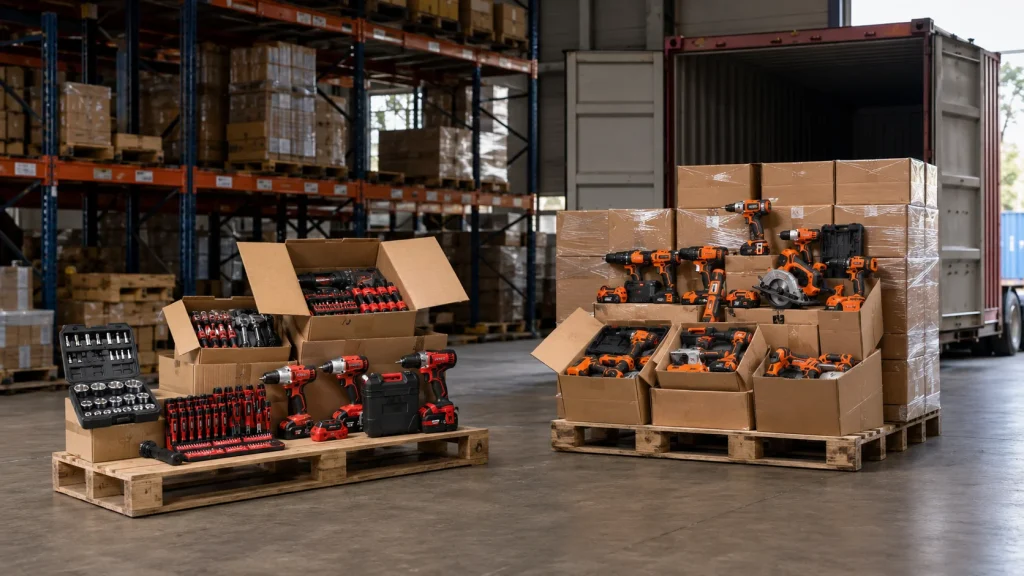
A full container load spreads the freight cost across the most units, giving the lowest shipping cost per tool. A small order shipped as less than a container load (LCL), or as a part container, carries a much higher freight share per unit. Customs clearance, broker fees, and documentation also have fixed elements that a small order cannot absorb as efficiently. The result is that the same tool can have a noticeably higher landed cost in a small first order than in a later full-container order. This is why a low minimum order quantity is useful at the start: it lets a distributor place a small order to learn their real landed cost and test the customs process before committing to full-container volumes.
Summary
How much you ultimately pay to import tools from China depends on the Incoterms, the destination country, and the order size. The safer approach is to estimate the full landed cost before placing an order, especially when entering a new market for the first time.
KAFUWELL supplies power tools and hand tools to distributors, wholesalers, and regional dealers worldwide. With low MOQs starting from one carton and mixed-product orders accepted, buyers can test quality, shipping, customs costs, and real landed cost before scaling up.