Mexico is the largest power tool market in Latin America, and China is its dominant supplier. For distributors and importers, the opportunity is substantial, but entering the market means meeting specific conditions: mandatory NOM certification, a 127V electrical standard, Spanish-language labeling, and a tariff environment that has shifted in recent years.
This guide explains what sells, what compliance requires, and what distributors should verify before placing an order.
Why Is Mexico a Growing Market for Power Tools?
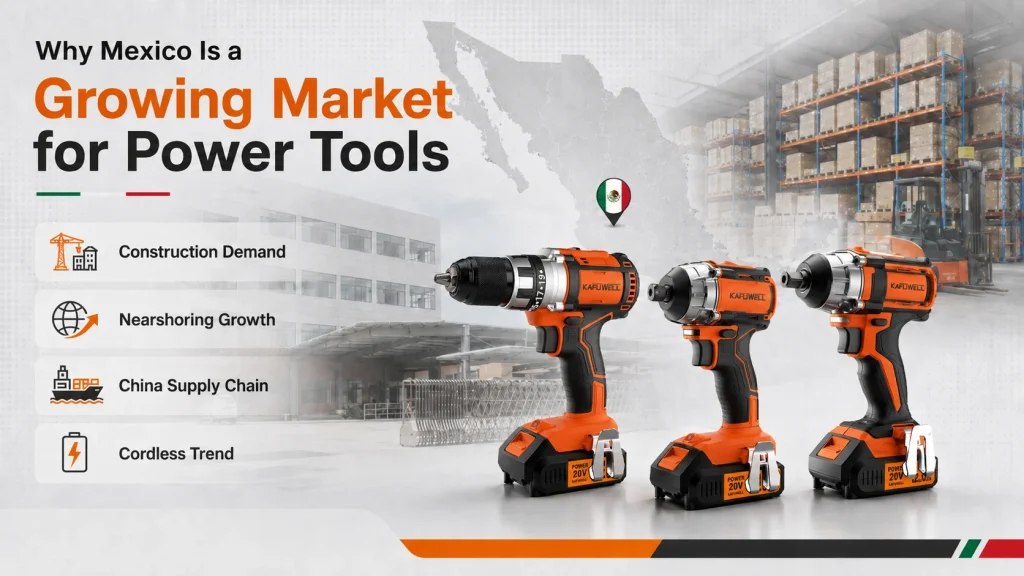
Mexico is the largest power tool market in Latin America and continues to expand. According to Grand View Research, the Mexican power tools market generated around 1.19 billion US dollars in revenue in 2025 and is projected to reach roughly 1.9 billion by 2033, growing at a compound annual rate of about 6.2% over that period. Several forces drive this demand.
Construction and infrastructure remain the foundation. Residential building, commercial development, and public works all consume drills, hammers, and saws in volume, and Mexico’s ongoing urbanization keeps this demand steady.
The nearshoring trend adds an industrial layer. As manufacturers relocate production closer to the United States, new factories and assembly lines across northern and central Mexico create fresh demand for industrial-grade tools and maintenance equipment. This shift has broadened the market beyond traditional construction and retail buyers.
China’s position as a supplier is decisive. According to trade data compiled by IndexBox, China is the single largest source of power tool imports into Mexico, supplying many times the volume of the next-largest origin country. For distributors sourcing from Chinese manufacturers, this means an established supply route, competitive pricing, and a familiar product mix already proven in the market.
One trend worth tracking is the shift toward cordless tools. Industry analysts expect the cordless segment to keep gaining share of unit sales through the end of the decade as professional users move away from corded models. For distributors, this means a stocking plan should weight cordless platforms more heavily over time, while corded tools continue to serve cost-sensitive and continuous-duty buyers.
Which Power Tools Sell Best in Mexico?
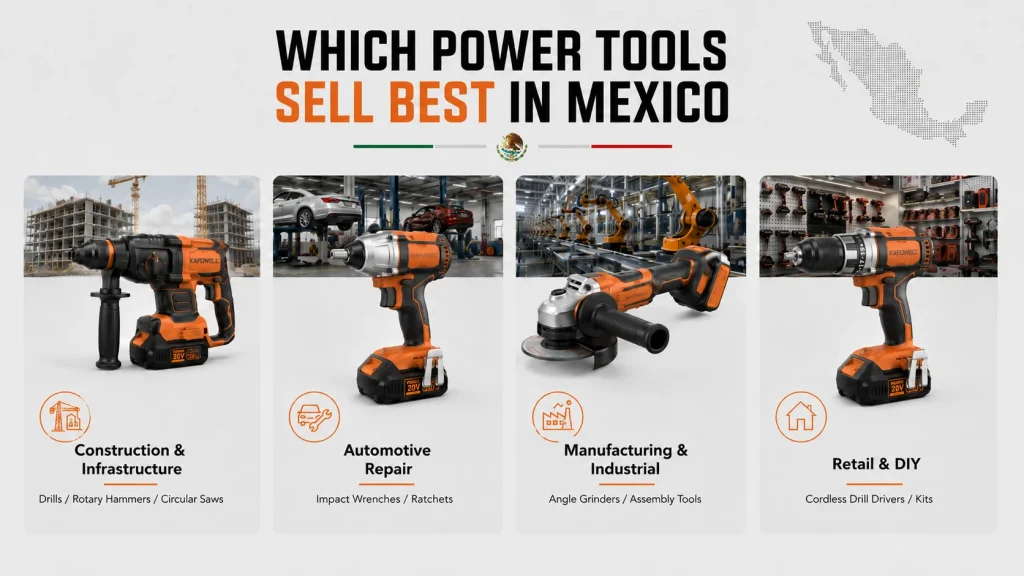
The strongest demand in Mexico falls into four broad categories, each tied to a different end market. Identifying which segment a buyer serves is the first step in shaping a stocking strategy.
Construction and Infrastructure Tools
Corded and cordless drills, rotary hammers, demolition hammers, and circular saws form the core of construction demand. These tools serve large contractors and the country’s substantial small-builder and informal construction sector, which favors durable, affordable equipment.
Automotive Repair Tools
Mexico has one of the largest automotive manufacturing and repair industries in the region. Impact wrenches, ratchet wrenches, and related fastening tools see consistent demand from repair shops, dealerships, and tire service centers across the country.
Manufacturing and Industrial Tools
The nearshoring wave has expanded factory activity. Angle grinders, electric screwdrivers, and assembly tools are needed on production lines and in maintenance departments, where reliability and continuous-duty performance matter more than price alone.
Retail and DIY Tools
A growing middle class supports retail and do-it-yourself demand. Cordless drill drivers, multi-tools, and starter kits move through hardware chains and online marketplaces, where cordless models are taking an increasing share of unit sales.
| Tool Category | Primary Demand Driver |
| Drills and rotary hammers | Construction and infrastructure |
| Impact wrenches and ratchets | Automotive repair sector |
| Angle grinders and assembly tools | Manufacturing and nearshoring |
| Cordless drill drivers and kits | Retail and DIY |
What Does NOM Certification Require for Power Tools?
NOM certification is mandatory for electrical power tools entering Mexico, and certifications from other markets do not satisfy it. The relevant standard is NOM-003-SCFI-2014, issued by Mexico’s Secretaria de Economia, which sets the safety requirements for electrical products. Power tools such as drills, saws, and sanders fall clearly within its scope, and the standard draws on Mexican norms including NMX-J-524/1, which is based on the international standard for handheld motor-operated tools (IEC 60745-1).
A CE mark or a UL listing carries no legal weight in Mexico. Products must hold valid NOM certification before they can clear customs and be sold legally, regardless of what other approvals they already hold.
Certification involves laboratory testing of product samples through an accredited body, document review, and ongoing surveillance. As of 2026, enforcement at the import and certification stages has become noticeably stricter, with additional surveillance requirements introduced for maintaining a valid certificate. Failing to meet these requirements can lead to suspension of the certificate and disruption at the border.
Labeling is part of compliance, not a separate step. Product labels and nameplates must appear in Spanish and include the manufacturer or importer name and address, the voltage, frequency, and power ratings, the NOM compliance mark or certificate number, and safety warnings in Spanish. The NOM mark must be clearly visible on the product or its packaging.
Tools with wireless or connected features may also require IFT certification from Mexico’s telecommunications regulator, which adds time to the overall approval process and should be factored into launch timelines.
One practical point often missed by first-time importers concerns who holds the certificate. NOM certification is tied to a certificate holder, and in some cases that holder can extend ownership to distributors, traders, or importers. Clarifying who will own and maintain the certificate before importing avoids a situation where a distributor depends on a certificate it cannot control or renew.
What Voltage and Plug Standards Does Mexico Use?
Mexico operates on a 127V electrical standard at 60 Hz, using Type A and Type B plugs, the same configuration found in the United States and Canada. Some industrial environments also use 220V.
| Specification | Mexico Standard |
| Voltage | 127V (220V in some industrial use) |
| Frequency | 60 Hz |
| Plug type | Type A and Type B |
This has a direct consequence for sourcing. Because Mexico uses 127V, distributors should confirm that their supplier can provide tools in the correct voltage version before placing an order. Ordering a 220V or 230V variant intended for another market can render an entire shipment unsellable, since the tools will not match the local grid and will fail at inspection or in the field. This is one of the most common and most expensive mistakes when importing into a 127V market, and it is entirely avoidable by confirming the voltage version up front.
How Does Mexico’s Import Tariff Environment Work?
Import costs in Mexico combine several elements, and the specific rates have shifted in recent years, so they should be verified before each order rather than assumed. The main components are the general import duty, known as the IGI, the value-added tax, known as the IVA, customs processing fees, and any applicable trade-defense measures.
Mexico does not have a free trade agreement with China, which affects the duty treatment of Chinese-origin goods. In recent years, Mexico has revised tariffs on imports from countries without a trade agreement, and these rates can change with limited notice. For this reason, the duty applied to a given tool depends on its correct HS code classification and on the rate in force at the time of import, not on a figure that held true in a previous year.
Rather than relying on a fixed number, distributors should confirm the current classification and rate through official Mexican sources, such as the national tariff schedule and the tax administration known as SAT, or through a licensed customs broker. Building a landed cost estimate around the current rate, rather than an outdated one, is the single most reliable way to prevent margin surprises after the goods arrive. A short verification at the quotation stage is far cheaper than discovering an unexpected duty once a container is already at port.
What Should Distributors Verify Before Importing?
Before committing to an order for the Mexican market, distributors should confirm the following points with the supplier and, where needed, a customs broker.
- NOM certification status: whether the product holds valid NOM-003-SCFI-2014 certification, and who owns the certificate.
- Voltage version: that the tools are built for 127V, not 220V or 230V.
- Spanish labeling: that labels, nameplates, and manuals meet the Spanish-language requirements.
- Tariff classification: the current HS code and duty rate, verified against official sources.
- Plug type: Type A or Type B configuration to match the local grid.
- Warranty and parts: after-sales terms and spare-part availability for the local market.
Working through this list before placing an order is what separates a smooth market entry from a shipment stuck in customs or returned by buyers.
Conclusion
Mexico is one of the most promising markets in Latin America for power tool distributors, but success depends on getting the details right. NOM-003-SCFI-2014 certification, Spanish-language labeling, and the correct 127V voltage version are just as important as competitive pricing.
Kafuwell supports power tool brand distribution partnerships, as well as OEM and ODM services. Buyers can customize voltage configurations and labeling based on the requirements of their target market. Distributors planning to enter the Mexican market can contact Kafuwell directly to discuss 127V product options and Spanish-language labeling. Product specifications can be downloaded from the Catalog Download page.