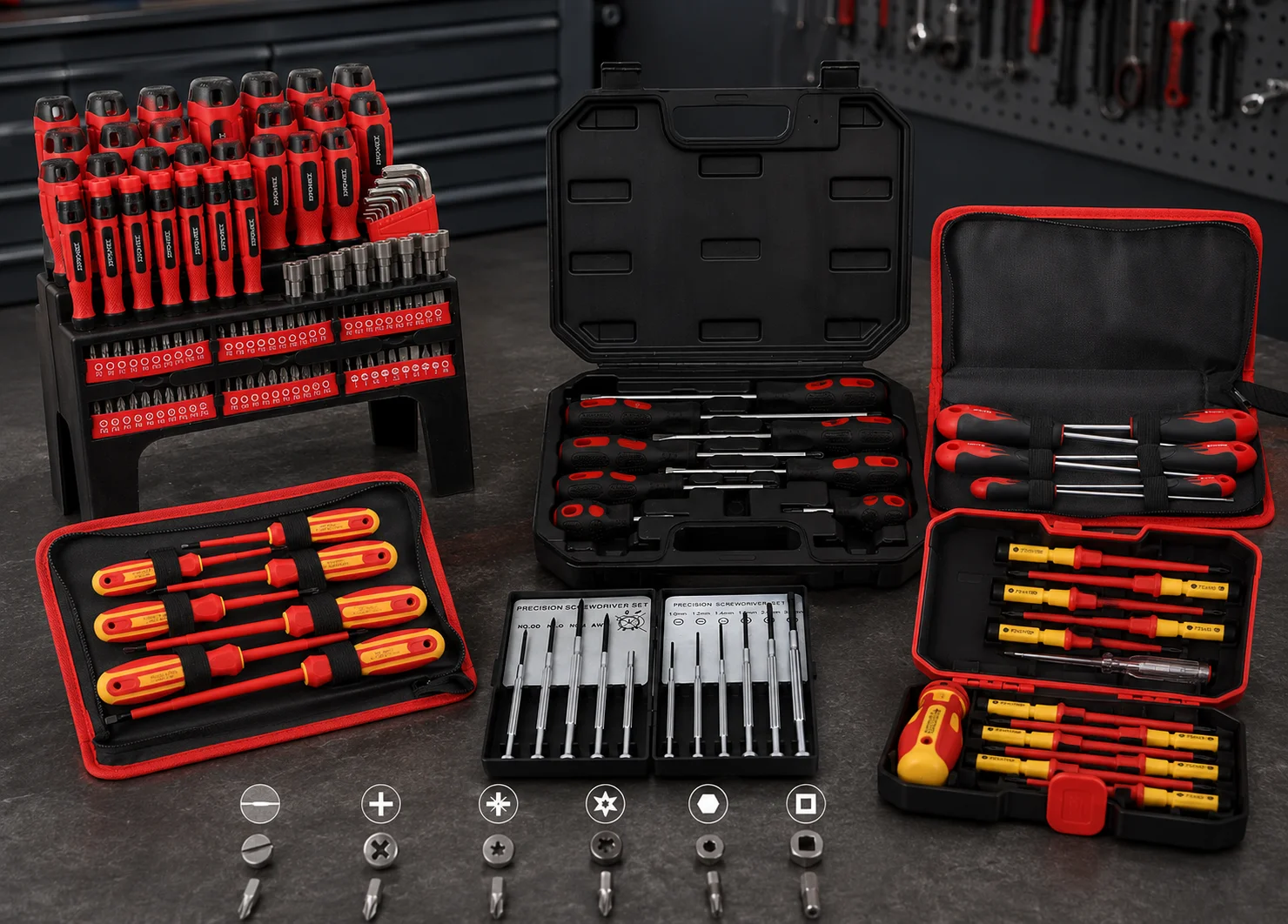
In modern building construction and installation engineering, power tools have evolved from “auxiliary equipment” into core productivity tools. They directly determine construction efficiency, safety levels, and project quality. For contractors, electricians, renovation companies, and wholesalers, choosing the right tools means choosing the right productivity.
This article takes real construction scenarios as its starting point and introduces common types of power tools used in building projects, along with practical selection advice.

Commonly Used Power Tools in Building Construction
Below, we introduce the most common categories of power tools used in construction, organized by “purpose + applicable work stages + key parameters + selection tips”.
1. Electric Drill / Cordless Drill
Main Uses
- Drilling holes in wood, thin steel plates, and profiles.
- Large-volume screw fastening and removal, such as keels, hardware, and accessory installation.
Applicable Work Stages
- Interior renovation, carpentry, light steel framing, and light installation tasks.
- Light metal processing, small brackets, and accessory installation.
Key Parameters
- Voltage platform: Common options include 12V, 18V, and 20V. Higher voltage generally means higher torque and broader application.
- Maximum torque: Determines whether long screws or large self-tapping screws can be driven easily.
- Chuck size: Commonly 10 mm or 13 mm. Larger chucks support a wider range of drill bits.
- Speed and torque settings: Multiple settings help balance drilling and fastening tasks.
Selection Tips
- For light renovation and maintenance, 12V–18V compact models are lightweight and reduce fatigue.
- For harder wood or thicker metal, choose a 20V platform with a brushless motor and higher torque.
- Models with hammer function (hammer drill / impact drill) can handle light concrete drilling, offering greater versatility.
2. Impact Drill / Hammer Drill / Rotary Hammer
Main Uses
- Drilling into concrete, brick walls, and stone.
- Installing expansion anchors and chemical anchors for brackets and equipment.
Applicable Work Stages
- Structural construction tasks such as reservations, reinforcement, and post-installed anchoring.
- HVAC, electrical, and fire protection support installations.
Key Parameters
- Impact energy and hammering frequency: Determine drilling efficiency in concrete.
- Chuck type: SDS+ for small to medium holes; SDS Max for larger diameters and heavy-duty applications.
- Maximum drilling diameter: Select based on commonly used anchor bolt sizes.
Selection Tips
- For renovation and light drilling, an impact drill with hammer function may be sufficient.
- For heavy concrete drilling or reinforced concrete, a professional rotary hammer is recommended.
- Professional teams should prioritize brushless motors and vibration-damping designs for comfort and durability.
3. Angle Grinder
Uses
- Cutting rebar, steel sections, bolts, and metal sheets.
- Grinding weld seams, deburring, chamfering, and rust removal.
- With diamond blades, some models can cut stone and tiles.
Applicable Work Stages
- Steel structure fabrication and installation, welding operations.
- Decorative finishing of stone, tiles, and metal trims.
Key Parameters
- Wheel diameter: Commonly 100–125 mm or larger. Larger diameters provide greater cutting depth.
- Rated power or voltage platform: Affects sustained cutting and grinding performance.
- No-load speed: Higher speed improves efficiency but requires higher-quality discs and better safety protection.
- Safety features: Guards, restart protection, overload protection, auxiliary handles.
Selection Tips
- For high-frequency jobsite use, choose professional-grade models with enhanced dust protection and safety features.
- For mobile or overhead work, cordless angle grinders with high-capacity batteries are more convenient.
4. Circular Saw / Miter Saw / Reciprocating Saw
Circular Saw
- Use: Straight cutting of boards, keels, and formwork; ideal for long, straight, high-efficiency cuts.
- Scenario: Carpentry, formwork, and bulk board processing.
Miter Saw
- Use: Precise angle and repeat cuts for door frames, skirting boards, and decorative moldings.
- Scenario: High-end renovations and fine woodworking details.
Reciprocating Saw
- Use: Demolition and cutting of old pipes, beams, and metal profiles in confined spaces.
- Scenario: Renovation, retrofitting, and emergency repair work.
Key Parameters
- Blade size: Determines maximum cutting depth and material compatibility.
- Stroke length and stroke rate (reciprocating saw): Affect cutting speed and smoothness.
- No-load speed or linear speed: Higher speeds cut faster but require more experience and safety awareness.
Selection Tips
- For standardized, repetitive cuts, circular or miter saws offer higher efficiency and cleaner cuts.
- For complex environments or demolition work, reciprocating saws provide versatility and access in tight spaces.
5. Sanders / Polishers
Uses
- Surface sanding of wood prior to painting or veneering.
- Polishing metal surfaces, removing burrs, and smoothing weld transitions.
Types
- Random orbital sander: Suitable for large flat surfaces, balancing efficiency and finish quality.
- Sheet sander: Ideal for edges, corners, and small detailed areas.
- Belt sander: Best for large areas, rough processing, and rapid material removal.
Key Parameters
- Pad size: Determines sanding coverage per pass.
- Variable speed: Different materials require different surface speeds.
- Dust collection: Design of dust ports and compatibility with vacuum systems.
Selection Tips
- Renovation and carpentry teams should prioritize random orbital sanders, supplemented by sheet sanders for fine detail.
- For projects with strict dust control requirements, choose models that support external dust extraction.
6. Power Saws / Cut-Off Machines (Stone, Tile, Metal)
Uses
- Tile cutting, stone slab cutting, and wall or floor slotting.
- Fixed-length cutting of steel, sections, and angle iron.
Types
- Handheld cutters: Flexible and suitable for on-site openings, slotting, and trimming.
- Bench cut-off machines: Ideal for batch processing and tasks requiring higher precision and repeatability.
Safety Notes
- Use blades or cutting discs matched to the correct speed and material.
- For wet cutting, ensure proper waterproofing, electrical safety, and anti-slip measures.
- Always wear safety goggles and masks to protect against debris and dust.
Selection Tips
- On-site construction typically favors handheld machines.
- Fixed workshops with large-volume cutting needs should be equipped with bench machines.
7. Impact Wrench / Electric Torque Wrench
Uses
- Fast tightening and removal of high-strength bolts, anchor bolts, flange connections, and vehicle wheel nuts.
Applicable Work Stages
- Steel structure installation projects.
- Mechanical and electrical equipment installation and maintenance.
- Vehicle and machinery servicing.
Key Parameters
- Maximum torque and adjustable torque levels: Determine bolt size capacity and torque control accuracy.
- Drive size: Such as 1/2″ or 3/4″, corresponding to different sockets and bolt sizes.
- Speed and impact rate: Affect efficiency and handling.
Selection Tips
- For steel structures and heavy equipment installation, choose high-torque, professional-grade impact wrenches.
- For mixed automotive and construction use, select mid-range torque models with multiple settings.
Common Power Tools and Electrician Tools for Electrical and Installation Work
Compared with structural construction, electrical and mechanical installation emphasizes precision and safety. In addition to general power tools, a full set of specialized electrician tools is essential.
1. Electric Screwdriver / Impact Driver
Uses
- High-volume fastening of switches, sockets, distribution box components, and cable trunking covers.
Key Points
- Torque range and adjustability: Prevents stripping screws or cracking plastic components.
- Voltage platform: 12V–20V are common; 18V/20V is recommended for frequent professional use.
- Quick-change bit system: Improves efficiency and reduces downtime.
2. Cable Cutters and Hydraulic Crimping Tools (Manual vs Electric)
Uses
- Cutting, stripping, and crimping large cables, one of the most critical steps in power distribution installation.
Comparison Points
- Manual tools: Suitable for smaller cable sizes and low volumes; lightweight but labor-intensive.
- Electric or hydraulic tools: Ideal for large cross-sections, high volume, and frequent use; higher efficiency and consistent quality.
3. Conduit Benders, Hole Saws, Sheet Metal Shears
Uses
- Conduit benders: Form metal conduits with consistent bend radius and clean appearance.
- Hole saws: Used with drills or impact drills to create standard openings in enclosures, trays, and panels.
- Sheet metal shears: For processing cable trays, covers, and thin metal components.
These tools often work in conjunction with drills and impact drills and are indispensable companions in electrical and mechanical installation.
4. Testing and Inspection Tools
Common Types
- Multimeters, voltage testers, clamp meters, voltage detectors, insulation resistance testers.
Functions
- Verify circuit and equipment safety before energizing, preventing miswiring, short circuits, and electric shock.
- Assist in fault diagnosis and reduce downtime during maintenance.

Key Selection Considerations: From “DIY Grade” to “Professional Grade”
When selecting power tools for projects or customers, consider the following dimensions to distinguish between household-grade and professional-grade tools.
1. Corded vs Cordless
Corded Tools
- Pros: High power output, strong continuous-duty capability, no battery limitations.
- Cons: Limited mobility due to power cords, less convenient in elevated or confined spaces.
Cordless Tools
- Pros: Excellent mobility, simpler setup, improved safety, ideal for elevated and complex job sites.
- Cons: Dependent on battery capacity and charging cycles, requiring battery rotation planning.
In practice, professional teams often upgrade high-frequency, distributed tasks to cordless platforms while retaining corded tools for heavy-duty or fixed stations.
2. Voltage Platform Selection (12V / 18V / 20V / 36V)
- 12V: Suitable for light loads, home renovation, and precision tasks; compact and flexible.
- 18V / 20V: The mainstream professional voltage platform, balancing power and weight and widely adopted.
- 36V and above: Used mainly for high-power cutting and heavy drilling; generally unnecessary for light installation or renovation.
3. Motor Type: Brushed vs Brushless
- Brushed motors: Simple structure and lower cost, but brushes wear out faster and generate more heat under heavy load.
- Brushless motors: Higher efficiency, longer lifespan, lower maintenance, ideal for professional and high-frequency use.
If budget allows, prioritize brushless platforms for construction sites and professional projects, reserving brushed tools for light-duty or backup roles.
4. Protection and Durability
- Dust protection: Sealed housings and optimized airflow reduce dust ingress into motors and switches.
- Water resistance and outdoor adaptability: Suitable for wet or outdoor environments.
- Structural strength: Drop-resistant and impact-resistant designs ensure reliability under frequent handling on job sites.
5. Compatibility and Platform Strategy
- A unified battery platform powering multiple tools simplifies battery and charger management.
- Purchasing tool kits within the same platform facilitates maintenance, spare parts stocking, and is especially beneficial for wholesalers and channel operations.
Conclusion
If you are looking for complete power tool solutions for projects or distribution channels, feel free to contact the KAFUWELL team. We can recommend suitable 20V cordless platforms and matching hand tools based on your project type, budget range, and target market, and provide OEM/ODM customization and one-stop B2B wholesale services.You can submit your project requirements via the online form at kafuwell.com, and we will provide a tailored tool configuration list and quotation within one business day.