When people first get into woodworking, many run into the same question: for a first saw, should they buy a circular saw or a table saw? Both tools are very common, and both can handle basic cutting tasks, but they differ in the kinds of work they suit, the budget they require, and the way they are used.
This article looks at the differences in function, project suitability, and real world needs to help you decide which one makes more sense as your first saw.
What Is the Real Difference Between a Circular Saw and a Table Saw?
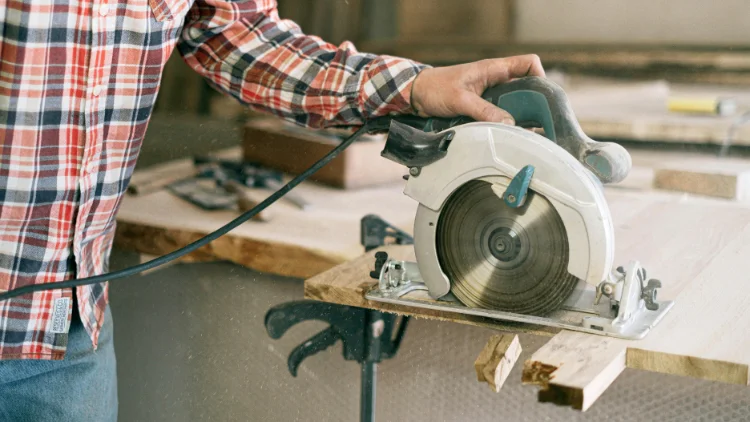
At the most basic level, both tools use a circular blade to cut wood. The real difference lies in where the blade is positioned and how the cut is made.
A circular saw is a handheld power tool. You move the saw along the material and guide it along the cut line. This structure makes it more flexible and better suited for use in different locations, especially when cutting full sheets of plywood, working on boards placed across sawhorses, or dealing with materials that are not convenient to move onto a fixed workstation.
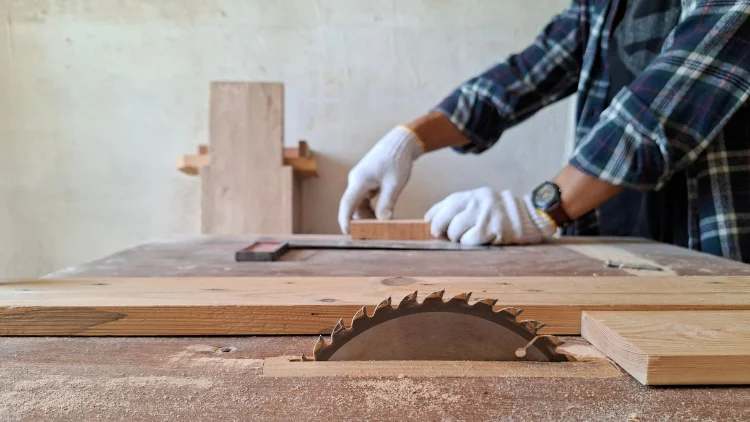
A table saw is a stationary machine. The blade protrudes through the tabletop, and instead of moving the saw, you move the material through the blade. This design makes the cutting process easier to control and better suited for straight, repeatable, and dimensionally consistent cuts.
This single difference shapes nearly all of the practical differences in user experience.
When using a circular saw, the saw moves to the material.
When using a table saw, the material is fed to the saw.
Why does that matter? Because woodworking is not just about cutting wood apart. What matters more is how efficiently, safely, and consistently you can make the right cut for the task at hand. If you often work with full sheets of plywood, a circular saw is usually easier to manage. If you frequently need precise rip cuts in solid wood boards, a table saw has a clear advantage.
Why Is a Circular Saw Usually Better as a First Saw for Beginners?
For most beginners, a circular saw is often the easier first purchase to justify. Not because it does everything better, but because it solves more of the most common early stage problems with fewer barriers.
The first advantage is cost. A circular saw is usually much more affordable than a table saw, which makes it a better fit for beginners buying their first serious tool. This matters because most people do not start woodworking with only one saw. They also need clamps, measuring tools, drill bits, safety gear, work supports, and various basic accessories. If too much of the budget goes into one large stationary machine at the start, the rest of the setup often falls behind.
The second advantage is portability. A circular saw is easy to carry and easy to store, which makes it practical in many situations where a table saw is simply inconvenient. If you work in a garage, driveway, backyard, apartment workspace, or shared area, portability is not just a bonus. It is a real advantage. You do not need a full workshop before a circular saw becomes useful.
The third advantage is that it works especially well for large sheet goods. Full sheets of plywood, MDF, and similar materials can be awkward to handle on many smaller table saws. With a circular saw, you can place the sheet on foam insulation boards or sawhorses, mark your line, clamp on a guide, and make the cut right where the material is. For many DIY users and woodworking beginners, this is one of the most useful and common cutting situations.
That is why a circular saw is so often recommended as a first saw. Even with limited space and a limited budget, it lets you start building right away.
What Projects Can You Do with a Circular Saw?
Many beginners underestimate how capable a circular saw can be. On its own, it is naturally less precise than a table saw, but when paired with a straightedge guide or a simple shop made jig, it becomes much more versatile.
A circular saw works well for projects such as:
Basic shelving
Garage storage
Workbenches
Outdoor furniture
Simple cabinets
Home repair tasks
Cuts related to framing work
Breaking down plywood into manageable sizes
For people focused more on practical builds than fine furniture at the beginning, this range of capability is often enough for quite a long time.
Where Does a Circular Saw Fall Short?
Although a circular saw is often the smarter first investment, it also has very clear limits. As projects demand more precision, those limits become more obvious.
The biggest issue is repeatable accuracy. Because it is a handheld tool, the quality of the cut depends heavily on your control, your guiding method, and how well your setup is prepared. A circular saw can absolutely cut straight, but compared with a table saw, it usually requires more setup and more operator attention, while a table saw can achieve the same result more easily with a fence.
The second limitation is ripping narrow stock. If you often need to cut solid wood boards into narrower strips, a circular saw becomes less convenient and less natural to use. It can still do the job in some cases, but it is not the method most woodworkers would choose first.
The third weakness appears in joinery and fine work. While some clever jigs can expand what a circular saw can do, it is still not the first choice for highly repeatable, high precision joinery work. Once your projects start depending on tighter tolerances, more stable dimensioning, and more consistent output, these limitations become very noticeable.
That is why many people start with a circular saw, but after some time, naturally see a table saw as the next major upgrade.
When Is a Table Saw the Better First Cutting Tool?
Although a circular saw makes more sense as a first saw for most people, there are definitely situations where starting with a table saw is more reasonable.
The most typical case is when your goal from the beginning is furniture making or cabinet work. These projects depend heavily on straight, repeatable cuts and accurate sizing of both sheet goods and solid wood. A table saw is naturally better suited for this because its design is built around controlled and repeatable cutting.
One of the biggest reasons is the rip fence. On a table saw, you can set the fence to a specific measurement and cut multiple pieces in succession with much better consistency and accuracy. Unless you are willing to clamp and reset a guide for every cut, a circular saw struggles to match that level of efficiency.
If you already have a dedicated workspace, a table saw can be an even more worthwhile first investment. As long as you have enough room for a stationary machine and you plan to do woodworking regularly rather than only occasional DIY, buying a table saw earlier can save time from the start and improve the quality of your work.
In other words, when your work depends more on precision than portability, a table saw becomes much more attractive.
Circular Saw vs Table Saw: Comparing Accuracy, Portability, Cost, and Versatility
If you are deciding which one to buy first, the comparison usually comes down to four things: accuracy, portability, cost, and versatility. Both tools are valuable, but they deliver value in different ways.
Accuracy
In most woodworking situations, a table saw clearly has the advantage in accuracy. Because the blade stays fixed and the material moves, it is easier to keep the cut straight, square, and repeatable. This is especially important when you need multiple parts to match, such as cabinet panels, shelves, framing parts, or furniture components.
A table saw also comes with a fence that helps keep the material at a fixed distance from the blade throughout the cut. Once the fence is set, you can repeat the same cut again and again without frequent recalibration. That natural repeatability is one of the main reasons a table saw becomes the central machine in many workshops.
A circular saw can also make clean and accurate cuts, but it usually needs extra setup to do so. Most users rely on a straightedge, a track, or a homemade jig to improve precision. Without these aids, the blade is more likely to drift slightly off line during the cut. For rough work, that may not matter much. For furniture or cabinet parts, it matters a great deal.
So if your work depends on higher precision from the start, a table saw has the advantage.
Portability
This is where the circular saw clearly wins.
A circular saw is small, easy to carry, and easy to store. Whether you are working in a garage, driveway, backyard, jobsite, or small workspace, it is easy to use and does not require a dedicated location. For beginners who do not yet have a permanent woodworking shop, this flexibility is extremely valuable.
By contrast, a table saw is not truly portable in real life, even when some models are marketed as jobsite saws. It takes up more space, needs a more stable setup, and is not ideal for being moved in and out for every temporary task. Once you buy a table saw, it usually stays in one place, or at least requires more preparation every time you use it.
If your work environment changes often, or you want a saw that can move with the material, a circular saw is clearly the better choice.
Cost
For most people, price is one of the most important deciding factors, especially when building out a tool system from scratch.
A circular saw is usually much cheaper than a table saw. Circular saws often range from about 80 to 300 dollars, while table saws are more commonly around 500 to 1500 dollars. That means after buying a circular saw, you may still have room in the budget for clamps, squares, sawhorses, measuring tools, work lights, hearing protection, and better blades. Because once you actually start working, the saw is never the whole story. What you need is a basic set of tools that work together.
A table saw requires a larger upfront investment. Even a smaller portable model usually costs noticeably more than a circular saw. And after buying one, you will often still want a better blade, outfeed support, or other upgraded accessories.
That does not mean a table saw is not worth it. For someone serious about woodworking, it may provide better long term value because it makes precise, repeatable work much more efficient. But at the beginner stage, a circular saw is usually the easier financial decision.
Versatility
The answer here really depends on how you define versatility.
If you mean going to many places, adapting to different environments, and handling a wide range of everyday DIY tasks, then a circular saw feels more versatile. It is flexible, easy to move, and capable of many kinds of cuts when paired with the right guide.
If you mean supporting deeper woodworking, tighter dimension control, more stable repeatability, and better long term workshop development, then a table saw is more versatile. That is because it is not just a cutting tool. It can also serve as a platform around which a whole processing system can be built. You can add fences, sleds, jigs, hold downs, and repeat cut setups.
So the circular saw is stronger in everyday flexibility, while the table saw is stronger in workshop level capability and expansion.
Quick Comparison: Circular Saw vs Table Saw
| Comparison Area | Circular Saw | Table Saw |
| Upfront Cost | Lower | Higher |
| Portability | Very strong | Weaker |
| Storage | Easy | Needs more space |
| Accuracy | Good with guides | Very strong |
| Repeat Cuts | Slower setup each time | Easier and faster |
| Full Sheet Plywood | Usually easier | Often more awkward |
| Narrow Rip Cuts | Less ideal | Better suited |
| Beginner Friendliness | Very suitable | Better for precision focused beginners |
| Long Term Workshop Growth | Moderate | Very strong |
Which Saw Is Better for Plywood, Boards, and DIY Projects?
The right answer depends on the material you cut most often.
Which Saw Is Better for Plywood?
If you often work with full sheets of plywood, a circular saw is usually the better choice.
Large panels can be difficult to control on many table saws, especially when the saw is small and your workspace is limited. Keeping a full sheet stable and controlled as you push it through the blade is not easy. A circular saw does the opposite. It allows the material to stay still while the saw moves across the surface, which is often much simpler.
That is why many cabinet makers and DIY users keep a circular saw in the shop even after buying a table saw. When it comes to breaking down large sheets, the circular saw is often the more practical tool.
Which Saw Is Better for Boards and Repeatable Straight Cuts?
If your work mainly involves cutting boards to a uniform width, a table saw has the advantage.
This is especially obvious in ripping. If you need to cut solid wood boards down to narrower sizes accurately, a table saw is faster, cleaner, and easier to keep consistent. The fence provides excellent control, and the larger tabletop supports the material better throughout the cut.
So for frequent board processing, a table saw is usually the more efficient option.
Which Saw Is Better for General DIY Projects?
For general household DIY, a circular saw is usually the better first purchase.
Many home projects do not require furniture grade precision. What they need more is practicality, a simple workflow, and a tool that can handle different materials in different locations. A circular saw fits that need very well. It can help you build shelves, storage, repair framing, handle outdoor projects, and break down sheet goods without requiring a full workshop.
That is why for people who are not yet planning to build a dedicated woodworking shop, a circular saw is usually the better answer.
Which Saw Is Better for Fine Woodworking?
If your focus is furniture, cabinetry, or projects where fit and dimensional consistency matter more, a table saw is usually the better choice.
Fine woodworking depends heavily on repeatability. When many parts need to match closely, a table saw reduces the time spent resetting for each cut and improves the consistency of the final output. Over time, that not only improves efficiency but also leads directly to better finished results.
Can a Circular Saw Replace a Table Saw?
A circular saw can do far more than many beginners expect. Especially when used with a straightedge or guide, it can cut straight lines, break down sheet goods, trim boards, and handle many DIY or construction related tasks very well. For some users, that is enough for a long time.
But if your work increasingly emphasizes precision and repeatability, it cannot fully replace a table saw.
The most obvious differences show up in narrow rip cuts, repeated sizing, and overall workflow efficiency. With a circular saw, you usually need to measure, clamp, guide, and adjust for each new group of cuts. With a table saw, once the fence is set, you can quickly make multiple identical cuts in sequence.
So yes, a circular saw can replace a table saw in some projects, but that kind of substitution usually depends on extra setup and operator skill, not because the circular saw naturally offers all the same strengths.
Can a Table Saw Replace a Circular Saw?
A table saw outperforms a circular saw in many core woodworking situations, especially inside the workshop. But it also cannot completely replace a circular saw.
The biggest reason is practicality. Full sheet materials, outdoor work, jobsite tasks, and materials that are not convenient to move onto a worktable are often easier to handle with a circular saw. Even woodworkers with a strong table saw setup often reach for a circular saw when the material is too large or when the task is not worth bringing back into the shop.
That is why this question usually does not end with one tool completely replacing the other. The real issue is which tool is better suited to which problem. In practice, many woodworkers eventually find that these two saws are complementary rather than purely competitive.
Based on Your Actual Needs, Which One Should You Buy First?
At this point, the answer is fairly clear. The best first saw for you does not depend on which tool is stronger overall. It depends on the kind of work you want to start doing first.
If You Care More About Cost and Flexibility, Buy a Circular Saw First
For most beginners, a circular saw is the smarter first investment.
It costs less, takes up less space, and covers a wide range of practical projects. If your current goals are home improvement, garage builds, workshop storage, basic shelving, small outdoor projects, or breaking down plywood, a circular saw can solve many problems without forcing you into the cost of a full woodworking shop from day one.
It also makes more sense if your space is limited. Not everyone has room for a stationary table saw, outfeed support, and a fully stable cutting area. A circular saw lets you work effectively in a driveway, garage, or even a small backyard.
You should prioritize a circular saw in situations like these:
Your budget is limited
You often work with plywood or large sheet materials
You mainly do general DIY or household projects
You need portability
You do not yet have a dedicated workshop
For many people, this is simply the most realistic starting point. And in woodworking, what is realistic often matters more than what looks ideal on paper. A tool you can afford now and use immediately is often more valuable than a more powerful machine that you cannot yet justify or properly use.
If Precision Is Central to Your Work, Buy a Table Saw First
When your projects depend on stable and repeatable accuracy from the beginning, a table saw is the better first choice.
If you plan to build furniture, cabinets, built ins, or frequently rip boards and perform more accurate dimensioning work, a table saw provides a much stronger workflow. It reduces the hassle of clamping guides for every cut and makes it easier to keep parts consistent, which gives you more confidence in precision focused projects.
If you already know woodworking will be a long term pursuit rather than an occasional weekend activity, buying a table saw earlier may actually save you time and frustration later because it provides a much stronger foundation for future work.
A table saw is usually the better first choice in situations like these:
You mainly want to build furniture or cabinets
You care deeply about repeatable precision
You often process solid wood boards
You already have room for a stationary machine
You want to gradually build a more complete woodworking shop
So although a circular saw is usually the better first saw for the average beginner, a table saw may actually be the more reasonable first purchase for those who care more about precision from the beginning.
Conclusion
If the question is which saw is more important in woodworking, the real answer is that both matter, but in different ways.In real applications, tool choice affects not only cutting results, but also efficiency, safety, and cost. For business buyers and distributors, stable product quality and reliable supply capacity are especially important. Kafuwell offers circular saws, table saws, and a complete power tool product line for metalworking, woodworking, construction, and other applications. Backed by a mature manufacturing system and stable quality, Kafuwell provides partners with more competitive product options. You are welcome to visit the Kafuwell download page for product materials.