Stick welding machines are one of the most widely distributed welding products in the world. However, when stocking them, many distributors do not clearly know how they work, which specifications truly influence buyers’ purchasing decisions, or how to build a product line that covers different customer needs. This article will answer these questions.
Why Stick Welding Machines Still Dominate Global Markets
The global arc welding equipment market was valued at over $10 billion in 2024 and continues to grow, driven by infrastructure investment across Asia, Africa, the Middle East, and Latin America. Within that market, Stick welding machines, also known as MMA (Manual Metal Arc) or SMAW (Shielded Metal Arc Welding) machines, account for the largest share of units sold globally.
The reason is straightforward. Stick welding requires no shielding gas supply, no wire feed system, and no fixed power infrastructure. A welder can carry the machine to any site, strike an arc, and get to work. In construction-heavy markets such as India, the Philippines, South Africa, and across the Middle East, that portability and simplicity makes Stick the default choice for contractors, repair shops, and field maintenance teams.
For distributors, that translates into high unit volume, broad end-user demand, and steady consumable sales from electrodes. Stick welding machines are one of the few product categories where a single SKU can move consistently across hardware retail, trade wholesale, and industrial supply channels simultaneously.
What Is a Stick Welding Machine?
A stick welding machine generates an electric arc between a consumable coated electrode, commonly called a “stick,” and the base metal being joined. The arc heat melts both the tip of the electrode and the surface of the base material, forming a weld pool. As the electrode burns, its flux coating releases shielding gas and forms a slag layer over the weld pool, protecting it from oxygen and moisture in the surrounding air. When the weld cools, the slag is chipped away, leaving a clean, solid joint.
The process is standardized under the designation SMAW (Shielded Metal Arc Welding) in North America and MMA (Manual Metal Arc) in Europe and most other markets. Both terms describe the same process. The designation ZX7 on Chinese-manufactured machines indicates a DC inverter arc welder built to this standard.
What is a stick welding machine used for?
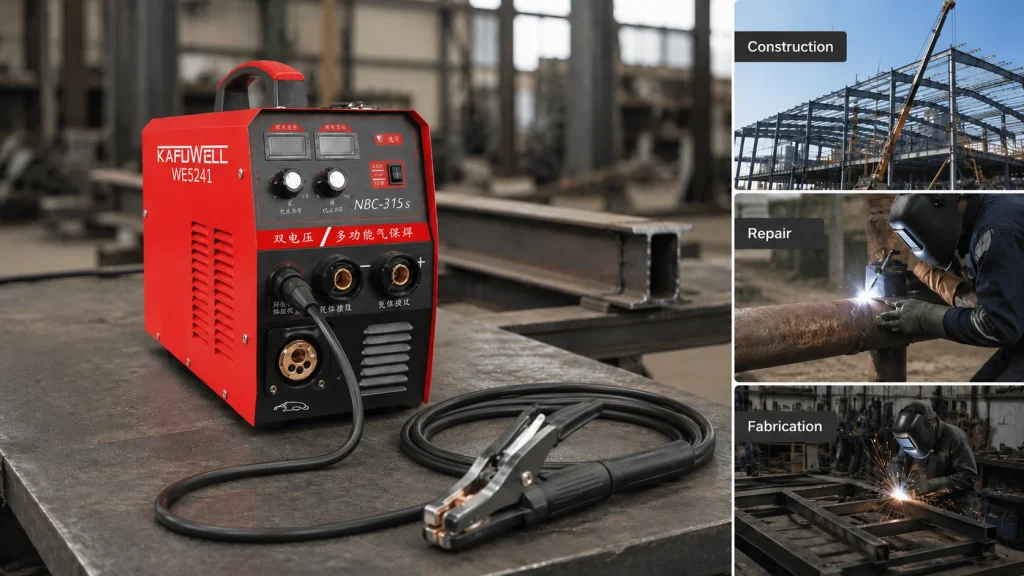
Stick welding machines handle a wide range of structural and repair applications across multiple industries. They are the preferred method wherever portability matters, gas supply is unavailable, or the base metal surface is imperfect.
| Industry | Typical Application | Why Stick Is Preferred |
| Construction | Structural steel joints, rebar | No shielding gas needed on site |
| Pipeline | Field pipe repair and joining | Works in all positions, fully portable |
| Automotive | Frame and chassis repair | Handles rusty, painted, or coated metal |
| Shipbuilding | Hull section and deck welding | Performs in confined and outdoor spaces |
| Agriculture | Equipment and machinery repair | Low setup cost, no gas infrastructure |
| Metal Fabrication | General structural welding | Handles thick materials effectively |
How Does a Stick Welding Machine Work? The Core Principles
Understanding the technical principles helps distributors answer buyer questions accurately and recommend the right machine for each application.
How the arc is generated. When the electrode tip makes contact with the base metal and is quickly withdrawn, the electrical resistance at that point generates intense heat, ionizing the air gap and sustaining an arc. The arc temperature reaches approximately 6,500 degrees Celsius, sufficient to melt most structural metals.
What the electrode coating does. The flux coating on the electrode performs three functions simultaneously. First, it stabilizes the arc by providing a consistent ionized path for the current. As it burns, carbon dioxide and other shielding gases are released, displacing atmospheric oxygen from the weld pool. A slag layer then forms over the cooling weld, slowing the cooling rate and preventing porosity.
DC vs. AC output. Most modern inverter-based Stick welders output direct current (DC). DC provides a smoother, more stable arc and works with a wider range of electrode types. AC output machines are older transformer designs, still used in some markets for specific electrode types, but DC inverter machines have largely replaced them in professional and industrial settings because of their better arc control and energy efficiency.
Inverter-based vs. transformer-based machines. Inverter technology converts incoming AC power to high-frequency DC, allowing the machine to be significantly lighter and more energy-efficient than older transformer-based designs. A modern inverter Stick welder delivering 140A of output can weigh under 4 kilograms. A transformer-based machine with similar output would weigh three to four times more. For distributors serving mobile contractors or markets where portability is a purchase driver, inverter machines are the correct category to stock.
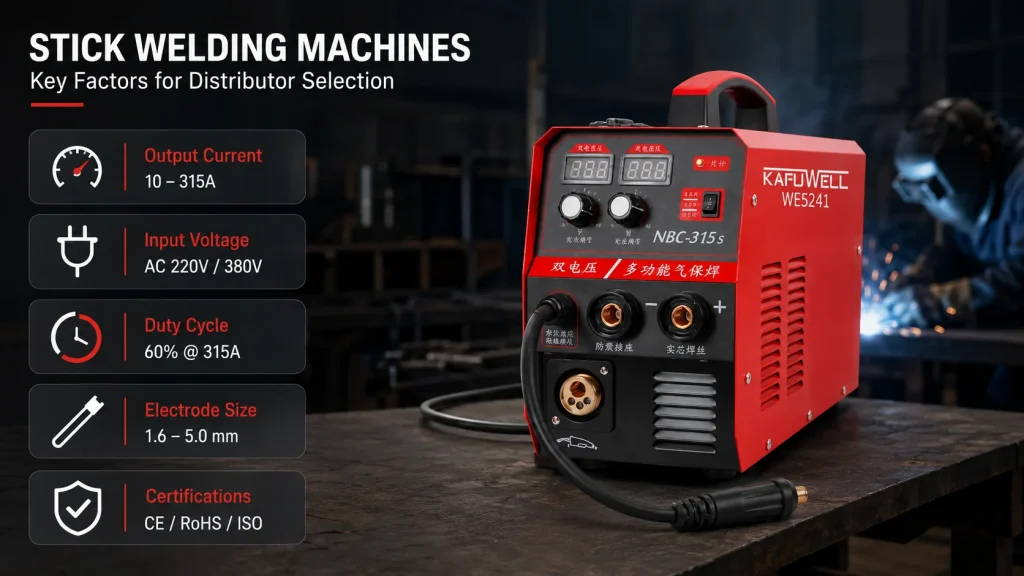
Duty cycle. Duty cycle is expressed as a percentage over a ten-minute period. A machine rated at 60% duty cycle at 140A can weld continuously for six minutes before requiring a four-minute cooling period. Professional buyers on active job sites need machines with duty cycle ratings that match their actual workflow. Distributors should confirm duty cycle specifications under rated load, not just peak output, when evaluating machines.
What Specs Do Distributors Need to Understand?
What output current range should distributors prioritize?
Output current range determines which materials and electrode sizes the machine can handle. The right range depends entirely on the end-user industries in a given market.
- 20 to 90A: thin sheet metal, light repair work, small 2.0mm electrodes
- 90 to 140A: general construction, fabrication, and repair trades, the highest-volume segment globally
- 140 to 200A: medium industrial applications, thicker structural steel, larger electrodes
- 200 to 315A: heavy industrial, pipeline, large-diameter electrodes, thick plate
The following Kafuwell models cover these tiers:
| Model | Current Range | No-Load Voltage | Input Voltage | Weight | Target Segment |
| WE5226 (ZX7-250T) | 30-140A | 65V | 220V | 3.8kg | General trades, construction repair |
| WE5234 (ZX7-400) | 0-200A | 75V | 220/380V | 8.0kg | Medium industrial, fabrication workshops |
| WE5230 (ZX7-315) | 20-315A | 90V | 220/380V | 5.3kg | Heavy industrial, large-scale projects |
Distributors entering the Stick welder category for the first time should lead with the 30-140A range. This segment covers the majority of construction trade and repair demand and generates the highest unit velocity. The 200A+ segment serves a smaller but higher-ticket buyer base and is appropriate once the entry tier is established.
What input voltage standard applies to your market?
- 220V single phase is standard for most residential, light commercial, and construction markets globally.
- 220/380V dual voltage is required for industrial factory environments where three-phase power is available and expected.
Distributors expanding into industrial supply channels, or entering markets with mixed grid standards, should prioritize dual-voltage models. The WE5230 and WE5234 both support 220/380V input, making them appropriate for markets where buyers may operate across different power environments.
Why does no-load voltage matter?
No-load voltage is the voltage present at the output terminals before the arc is struck. Higher no-load voltage makes it easier to initiate and restrike the arc, which matters particularly for less experienced welders or for applications involving contaminated or coated base metals. Among the Kafuwell Stick welder range, no-load voltage runs from 65V on the WE5226 to 90V on the WE5230, reflecting the heavier-duty positioning of the latter.
What electrode compatibility should distributors confirm?
Stick welders use consumable coated electrodes in standard diameters. The three most common sizes are:
- 2.5mm: thin materials and precision repair work
- 3.2mm: general-purpose structural welding, the highest-volume consumable diameter globally
- 4.0mm: heavy structural applications, thick plate
All three Kafuwell Stick welder models are compatible with 2.5, 3.2, and 4.0mm electrodes. Before committing to stock, distributors should confirm that 3.2mm electrodes are available from local consumable suppliers. Electrode availability gaps are the most common cause of after-sales friction for welding distributors.
What certifications are required by market?
| Market | Required Certification |
| European Union | CE |
| North America | ETL or UL |
| Most regulated markets | ROHS |
| Germany and DACH region | GS |
Distributors should request original certification documents from the manufacturer, not scanned copies, and verify that the certificate covers the specific model being ordered. Certification mismatches are a common cause of customs delays and market withdrawal issues.
How Should Distributors Choose the Right Stick Welding Models to Stock?
Step 1: Map your end-user industries
Begin by identifying the dominant industries in your distribution territory that purchase welding equipment. A territory with high construction activity and a large trade contractor base will generate sustained demand for the 30-140A range at 220V. A territory serving manufacturing facilities or steel fabricators will require dual-voltage models and higher current capacity.
Markets in Southeast Asia, the Middle East, and Sub-Saharan Africa typically show the highest concentration of construction and field repair demand, making the WE5226 the natural volume SKU for those regions. Markets with more developed industrial infrastructure will absorb the WE5230 and WE5234 alongside the entry tier.
Step 2: Match input voltage to your market grid standard
Confirm the dominant grid voltage in your territory before placing an order. Stocking 220V-only machines for a market where industrial buyers require 380V creates return risk and limits your addressable customer base. Dual-voltage models eliminate that constraint and give distributors flexibility when the buyer base is mixed.
Step 3: Build a tiered SKU structure
A single SKU rarely covers the full range of buyer needs in any market. A two-tier structure, one entry model and one mid-range or heavy model, covers the majority of demand while managing inventory risk.
For most markets, the recommended starting structure is the WE5226 as the volume driver and the WE5230 as the industrial upgrade option. The WE5230 combines a wide current range of 20-315A with a manageable weight of 5.3 kilograms, making it suitable for both workshop and semi-portable industrial use without requiring the full 8-kilogram commitment of the WE5234.
Step 4: Verify electrode availability before committing to stock
Confirm with local consumable suppliers that 3.2mm electrodes matching the electrode types compatible with your chosen machines are consistently available. This step should happen before the purchase order, not after. An end user who cannot source replacement electrodes will not reorder the machine from the same distributor.
Step 5: Confirm certifications against your import requirements
Request the full certification package for each model: CE certificates, test reports, and ROHS declarations as applicable to your target market. Verify that the certificates are current, cover the exact model number being ordered, and are issued by an accredited third-party testing body. This documentation protects the distributor at customs and provides the technical backing needed for buyers in regulated procurement environments.
Step 6: Assess manufacturer after-sales support
Evaluate the manufacturer’s support structure before committing to a product line. Key questions to ask:
- Are spare parts including IGBT modules, carbon brushes, and welding cables available separately?
- What is the warranty period and what does it cover?
- Is a user manual available in English or the local language of your market?
- Does the manufacturer provide technical support for distributor after-sales queries?
Step 7: Calculate landed cost and target margin
Build a complete cost model before finalizing the order. Landed cost should include the unit price, ocean or air freight, import duties, local certification fees if applicable, and warehousing. Typical distributor margin on MMA welders runs between 25% and 40% depending on market, channel, and volume tier. Confirm MOQ requirements and tiered pricing thresholds with the manufacturer to understand the volume at which margin improves.
Summarize
Kafuwell’s stick welding machine series covers multiple tiers, including portable entry-level, medium industrial, and heavy-duty applications, helping distributors build broader market coverage with fewer SKUs. If you are looking for a reliable welding equipment supplier, or want to build a more suitable stick welding machine product line based on your local market demand, please contact us.
The Kafuwell team can provide product model recommendations, specification materials, certification documents, and distributor partnership support to help you enter or expand in the welding equipment market more efficiently.