Socket sizes confuse buyers because two different things are being measured. One is the drive size, the square fitting that connects the socket to the ratchet. The other is the socket size, the hex opening that fits the fastener. On top of that, socket sizes come in two systems, metric and SAE. This guide breaks down both and explains which sizes are worth stocking.
What Is the Difference Between Drive Size and Socket Size?
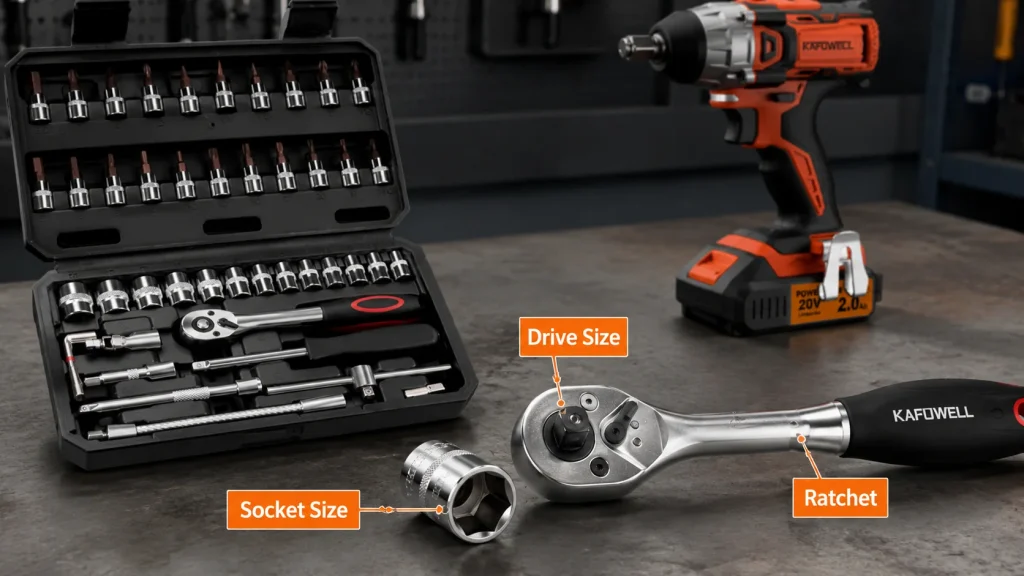
A socket has two separate measurements, and confusing them is the most common mistake buyers make. The drive size is the square hole on top of the socket that locks onto the ratchet or breaker bar. The socket size is the hex opening at the bottom that grips the bolt or nut. A single 1/2-inch drive ratchet can run dozens of different socket sizes, from small to large, as long as they share the same 1/2-inch drive.
Drive size determines how much torque the system can handle. Socket size determines which fastener it fits. The two are independent: a large socket on a small drive is limited by the drive, not the socket.
What Are the Standard Socket Drive Sizes?
There are five standard socket drive sizes, and they are always expressed in inches, even on fully metric sets. The larger the drive, the more torque the system can transmit.
| Drive Size | Typical Socket Range | Common Applications |
| 1/4″ (6.3 mm) | 4-15 mm / 5/32″-9/16″ | Electronics, small engines, interior trim, precision work |
| 3/8″ (9.5 mm) | 6-22 mm / 1/4″-7/8″ | General automotive, household repair, light industrial |
| 1/2″ (12.7 mm) | 10-32 mm / 3/8″-1-1/4″ | Heavy automotive, suspension, machinery |
| 3/4″ (19.0 mm) | 19-50 mm / 3/4″-2″ | Industrial, trucks, construction |
| 1″ (25.4 mm) | 25 mm and up | Heavy industrial, agricultural equipment |
The 3/8-inch drive is the most versatile and the usual starting point for a general set, covering the majority of automotive and maintenance fasteners. A common rule among tradespeople is to stay on 3/8-inch drive for sockets up to 19 mm, then move to 1/2-inch drive for anything larger or higher in torque. The 1/4-inch drive handles light, precise work, while the 3/4-inch and 1-inch drives are reserved for industrial and heavy equipment.
Metric vs SAE Socket Sizes: What Is the Difference?
Socket sizes come in two measurement systems, and they are not interchangeable. Metric sockets are sized in millimeters, such as 10 mm or 13 mm, and are used across most of the world, including for European and Asian vehicles and equipment. SAE sockets, named for the Society of Automotive Engineers, are sized in fractions of an inch, such as 3/8 inch or 1/2 inch, and are common on American-built vehicles, agricultural machinery, and older equipment.
The two systems have sizes that look close but are rarely identical. The table below shows the nearest matches.
| Metric | Closest SAE |
| 8 mm | 5/16″ |
| 10 mm | 3/8″ |
| 13 mm | 1/2″ |
| 14 mm | 9/16″ |
| 16 mm | 5/8″ |
| 19 mm | 3/4″ |
| 22 mm | 7/8″ |
Only 19 mm and 3/4 inch are nearly exact, at about 19.05 mm. The rest are close but not equal, and using a slightly oversized socket on a torqued fastener can round off the corners of the bolt head. For any fastener that will be torqued, the matching system should always be used.
What Socket Sizes Should Distributors Stock?
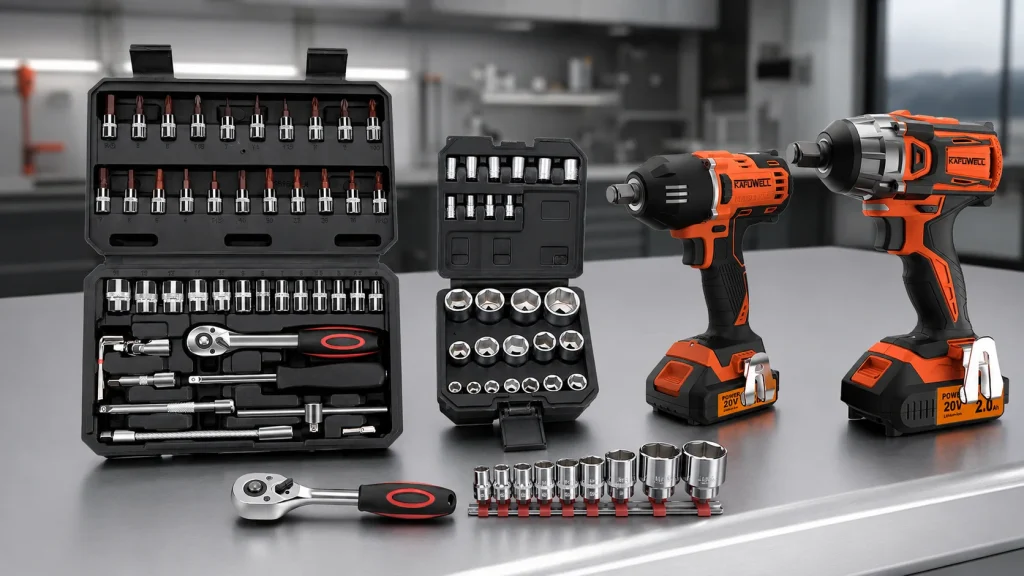
For distributors, the 3/8-inch and 1/2-inch drives are the volume movers, and a band of mid-range socket sizes covers most everyday demand. These two drives suit the bulk of automotive, maintenance, and general repair work, which is where most retail and trade demand sits. The 1/4-inch drive is worth stocking as a complement for precision work, while the 3/4-inch and 1-inch drives are specialist items for industrial buyers.
Within each drive, the most-used socket sizes follow a familiar pattern. In metric, roughly 8 mm to 19 mm see the heaviest use. In SAE, the equivalent band runs from about 3/8 inch to 3/4 inch. Stocking both systems matters for distributors serving export markets, since the right system depends on whether local vehicles and equipment are metric or SAE. Markets with many American-built vehicles need SAE coverage, while most others lean metric.
Complete sets in 1/4-inch, 3/8-inch, and 1/2-inch drive remain the strongest sellers through retail channels, since they give end users a full range in a single purchase. For trade and industrial buyers, individual sockets and replacements in the common sizes are steady repeat business. Impact-rated sockets are a separate demand category with their own requirements, worth weighing alongside standard chrome sockets depending on the market.
Summary
Two numbers define every socket: the drive size that sets torque capacity, and the socket size that fits the fastener, with both metric and SAE versions of the latter. Getting the assortment right means covering the high-use drives, 3/8 inch and 1/2 inch, across the most common sizes in both systems.
KAFUWELL produces socket sets in 1/4-inch, 3/8-inch, and 1/2-inch drives, sized in metric, with blow-molded cases, metal boxes, or foam trays that fit standard tool cabinets. We also make the impact wrenches and ratchets that drive them, so the sockets and the tools behind them come from one factory. For piece counts, size ranges, and packaging dimensions, see our product catalog.Beyond socket sets, we also make the impact wrenches that drive them, along with a full range of power tools, so distributors can source the sockets and the tools behind them from one factory.