Walk through any gas station, auto repair shop, woodworking studio, or food packaging line and you will find the same machine quietly doing the work behind the scenes: an air compressor. It powers the impact wrench that swaps your tires, the spray gun that paints your car, the nail gun that builds your home, and the air knives that dry bottles on a production line.
An air compressor is a machine that converts electrical or mechanical power into pressurized air, which is then released on demand to drive tools, spray fluids, inflate objects, clean surfaces, and supply air to industrial processes. It is one of the most versatile machines in any workshop or production facility.
This guide walks through what air compressors are actually used for — the most common applications, the typical settings, the jobs they are not suited for, and how to choose the right one.
How an Air Compressor Works
An air compressor draws in ambient air, compresses it inside a pump, and stores it in a tank under pressure. When you open the outlet valve, that stored air flows through a hose to power a tool or fill an object. A regulator controls the working pressure delivered downstream, and a pressure switch starts and stops the motor to keep the tank topped up.
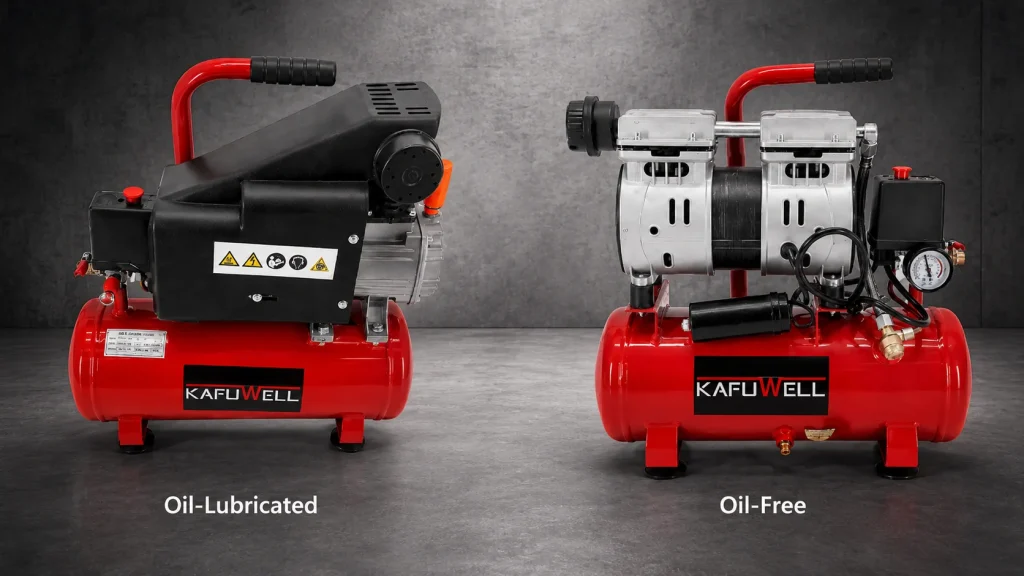
Most portable and workshop-class compressors use one of two pump designs. Oil-lubricated pumps run cooler and last longer under heavy daily use. Oil-free pumps deliver cleaner air and need no oil maintenance, making them standard for mobile and clean-air work. Two specifications decide what a compressor can do: pressure (PSI, MPa, or bar) and air flow (CFM or L/min).
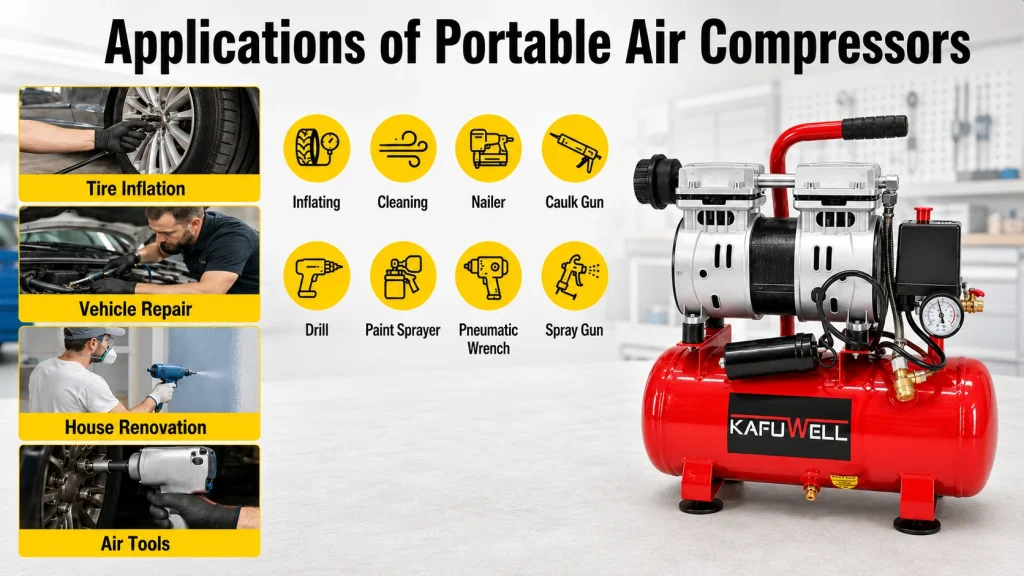
Main Applications of an Air Compressor
Powering Pneumatic Tools
The most widespread use of an air compressor is to power pneumatic — or “air” — tools. Professionals across nearly every trade reach for them because they offer a higher power-to-weight ratio than corded electric tools, run cool under continuous use, last longer with fewer wearing parts, and are safer in flammable or dusty environments.
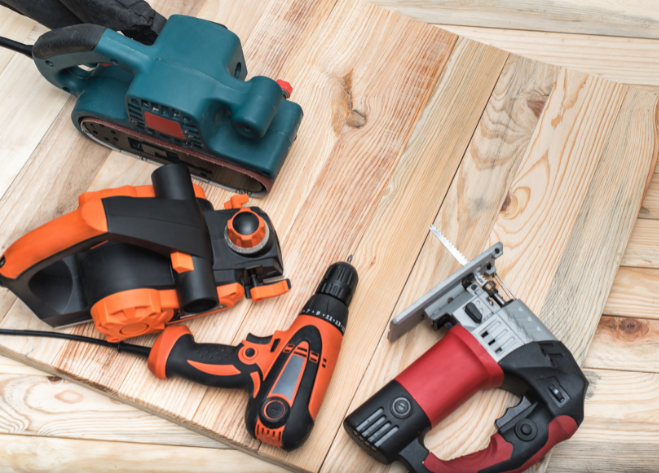
The pneumatic tools you will encounter most often include nail guns and staplers (brad, finish, framing, roofing), impact wrenches and air ratchets, pneumatic drills, die grinders and small angle grinders, orbital and pad sanders for body work and finishing, and spray guns for paint and coatings.
Every pneumatic tool has its own air consumption, usually given in CFM at 90 PSI. The rule of thumb: size your compressor for the thirstiest tool you plan to run, then add 50 percent headroom so it is not running flat out.
Inflating Tires and Equipment
The second most common job is inflation. This covers car, truck, motorcycle, bicycle, ATV, trailer, and wheelbarrow tires, plus sports balls, pool toys, inflatable furniture, air mattresses, paddleboards, and small commercial pressure vessels.
Inflation is one of the gentlest jobs you can ask a compressor to do. Most consumer tires inflate to well under the 116 PSI a 0.8 MPa compressor can supply, and inflation consumes very little CFM, so even a small 9L portable unit handles it effortlessly. For a mobile technician or service van, a compact compressor doubles as a roadside tire kit.
Spray Painting and Finishing
Compressed air is the engine behind most professional spray finishing. From automotive refinishing to furniture lacquering, the compressor delivers the steady airflow a spray gun needs to atomize paint into a fine, even mist.
Typical applications include automotive body and panel paint, furniture and cabinetry clear coats, interior and exterior wall painting, texture spraying, and detail work with small-pattern guns and airbrushes.
For finish work, the cleanliness of the air matters as much as the volume. Trace amounts of oil mist from an oil-lubricated compressor can cause fisheyes, blemishes, and adhesion failure in the finished coat. This is why oil-free compressors — or oil-lubricated units paired with high-quality coalescing filters — are the standard choice for paint and finishing shops.
Cleaning, Blowing, and Drying
A controlled jet of compressed air is the fastest way to clean, dry, or clear surfaces that water and brushes cannot reach. Typical jobs include blowing sawdust and metal chips off workbenches and machinery, drying washed parts before painting, clearing debris around door and window frames after sanding, cleaning HVAC condenser coils and electrical enclosures, and blowing out plumbing or sprinkler lines before winter.
For sensitive electronics, food-contact surfaces, or any clean environment, an oil-free compressor is the safer choice — even a small amount of oil residue can damage circuit boards or contaminate products downstream.
Light Industrial and Specialized Applications
Beyond hand tools and finishing, compressed air drives a long list of more specialized jobs:
- Pneumatic clamps and assembly jigs that hold parts in place during welding, gluing, or machining
- Light sandblasting and bead blasting for cleaning rust off small parts, brackets, and hardware
- Pressure testing of pipes, vessels, valves, and weld seams for leaks
- Light pneumatic conveying of granules, powders, or packaging materials
- Air horns, signaling, and pneumatic actuators in small production equipment
These usually call for a 30L or 50L tank to keep pressure steady. One honest note: heavy continuous sandblasting on large surfaces needs a far bigger compressor than any shop-class unit can supply. Shop compressors handle spot blasting and small parts cleanup, not full-panel work.
Clean-Air Applications in Food, Medical, and Lab Settings
Some industries cannot tolerate even microscopic oil contamination in their compressed air. Here, oil-free is not a preference — it is mandatory.
- Food and beverage — bottle blow-off, packaging air knives, fill-line assists
- Dental clinics — handpiece drives and air-water syringes (medical-grade systems required for direct patient air)
- Laboratories and pharmacies — analytical instrument air supply, sample drying, pneumatic actuators
Compressed air in any food, medical, or pharmaceutical context must meet specific purity standards — ISO 8573 is the most common benchmark. The compressor must be oil-free, with downstream filtration and drying added to remove moisture and particulates.
What an Air Compressor Is Not Used For
An air compressor is not the same as an air conditioner compressor. The compressor inside your air conditioner or refrigerator compresses refrigerant inside a sealed cooling loop. The compressors in this article compress air for tools and processes — completely different machines that share a name.
A shop air compressor cannot fill scuba, paintball, or SCBA tanks. Those high-pressure cylinders need 3,000 PSI or more and specialized breathing-air compressors. A typical shop compressor maxes out around 116 to 150 PSI.
A portable compressor will not sustain heavy continuous high-CFM work like full-panel sandblasting, large-scale pneumatic conveying, or factory production tooling. Those jobs need rotary screw or large industrial reciprocating units.
Undersizing leads to disappointment. A 9L unit paired with a continuous-duty sander or large impact wrench will short-cycle, overheat, and fail to keep up. Matching the compressor to the work is the most important decision you will make as a buyer.
Read more: How to Use an Air Compressor
How to Choose the Right Air Compressor for Your Application
Picking the right air compressor comes down to four practical questions.
1. What is the total CFM demand of your tools? Look up each tool’s CFM rating at 90 PSI. If only one tool will run at a time, take the highest. If two or more tools will run simultaneously, add their CFM together first. Then multiply that number by 1.5 for headroom and choose a compressor that delivers at least that much.
2. What working pressure do your tools need? Most pneumatic tools are rated for 90 PSI. A compressor with a maximum delivery of 0.8 MPa (about 116 PSI) gives comfortable pressure headroom for nailers, impact wrenches, air ratchets, spray guns, and small sanders. Keep in mind that sufficient pressure does not guarantee sufficient flow — for continuous-duty tools like spray guns and sanders, CFM is the more critical spec.
3. How much air reserve do you need between motor cycles? Tank size determines how long the compressor can run a tool before the pump kicks back on:
- 9L (~2.4 gal): intermittent use — tire inflation, finish nailers, light cleaning, mobile work
- 30L (~8 gal): small workshops running light to medium tools intermittently (nailers, ratchets, occasional inflation)
- 50L (~13 gal): busier shops, intermittent spray work with touch-up or mini-HVLP guns, multi-tool operations with short rest cycles
4. Do you need clean air or maximum durability? Choose oil-free for spray painting, food, dental, lab, and mobile work, or for users who do not want oil maintenance. Choose oil-lubricated for heavy daily use, longer service life, and workshop environments with higher durability demands.
A final note for international buyers: confirm the compressor’s voltage and frequency match your local supply. A 220–240V/50Hz machine will not start on a 110V outlet, and a 110V machine plugged into a 220V outlet will be permanently damaged within seconds — one of the most common mistakes in cross-border sourcing.
Frequently Asked Questions
How long does an air compressor typically last?
Lifespan depends on type, duty cycle, and maintenance. A well-maintained oil-lubricated compressor used moderately can last 10 to 15 years; under heavy daily commercial use, expect 5 to 8 years. Oil-free units generally run 3 to 8 years, with start-stop frequency the main wear factor. Regular tank draining, intake filter changes, and oil changes can significantly extend the practical lifespan.
Do air compressors run out of air?
Not exactly. As long as the motor has power, the compressor keeps producing compressed air. What can happen is the stored air in the tank gets used faster than the pump can replenish it — which is why a continuous-duty tool like a sander will outpace an undersized compressor and pressure will drop until the motor catches up. Matching tool CFM to compressor output prevents this.
What is the difference between a single-stage and a two-stage air compressor?
A single-stage compressor compresses air to its final pressure in one stroke. Most portable and shop-class compressors are single-stage and top out around 120 PSI. A two-stage compressor compresses air twice — first to an intermediate pressure, then to a final 150 to 175 PSI — and is built for industrial duty cycles. For workshops, auto shops, woodworking studios, and most light manufacturing, a single-stage compressor is more than enough.
Why does water build up inside the tank, and should I drain it?
The air around you contains water vapor. When it is compressed, the vapor condenses into liquid inside the tank. Water collection is normal — but it must be drained regularly, or it will rust the tank from the inside, contaminate spray paint and downstream tools, and shorten the compressor’s life. Open the drain valve after every heavy session, and at least weekly for any compressor in regular use.
How can I reduce the noise from my air compressor?
A few practical steps make a real difference: choose a low-noise oil-free model (typically 70–75 dB versus 80+ dB for budget oil-lubricated units), place the unit on rubber anti-vibration feet, build a ventilated sound enclosure or move it behind a wall, add a muffler at the intake, and keep the compressor maintained — loose fasteners and worn bearings increase noise sharply as a unit ages.
Summarize
Air compressors are among the most versatile machines you can put into a workshop, garage, or production line. From a small portable unit topping off a tire to a 50L workshop machine running spray guns in a body shop, the right compressor multiplies what one person can do. The key is to think in terms of CFM, pressure, duty cycle, and air purity.
KAFUWELL manufactures a complete range of portable oil-free and oil-lubricated air compressors for workshops, mobile technicians, finishing shops, and small manufacturing applications. Our air compressors are available with tank capacities from 9L to 50L, deliver up to 120 L/min at 0.8 MPa, and are CE certified for global markets. You can visit our Power Equipments category to compare different models or contact us for a quote.