Whether you’re refinishing an old dining table or prepping a wall before painting, chances are someone has told you to grab an orbital sander.
But if you’ve never used one — or you’re evaluating sanders for your product line — it helps to understand exactly what this tool is, how it works, and where it genuinely shines. This guide covers everything you need to know.
What Is an Orbital Sander?
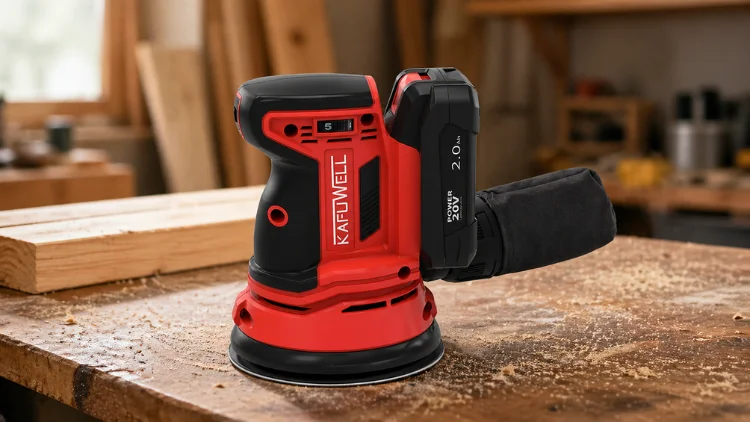
An orbital sander is a handheld power tool that smooths surfaces by moving a sanding disc in a rapid, elliptical (orbital) pattern. Unlike a belt sander that moves in one straight direction, or a detail sander that works in tight corners, the orbital sander’s disc spins and oscillates simultaneously — which is why the full name is often random orbital sander.
That randomness is the key. Because the disc never traces the same path twice, it drastically reduces the swirl marks and scratches that single-direction sanders leave behind. The result is a smoother, cleaner finish with far less effort.
Key specs to know when buying or stocking an orbital sander:
- Disc size: Most models use 5-inch or 6-inch sanding pads. Larger discs cover more surface area; smaller ones are easier to control.
- OPM (orbits per minute): Typically ranges from 8,000 to 14,000 OPM. Higher OPM means faster material removal.
- Variable speed: Better models include a speed dial, letting users match the tool’s aggression to the task.
- Dust collection: A built-in dust port (compatible with a vacuum or dust bag) is essential for clean job sites and longer sandpaper life.
- Corded vs. cordless: Corded models offer consistent power for long sessions; cordless models (typically 20V lithium) provide freedom of movement — increasingly the preferred choice for both professionals and DIYers.
How Does an Orbital Sander Work?
The sanding pad on an orbital sander does two things at once: it spins on its own axis while simultaneously moving in small, random ellipses. This dual motion is what sets it apart from a standard “orbital” (non-random) sander, which only moves in fixed circles and is more likely to leave visible scratch patterns.
Here’s why the random motion matters in practice:
- No repeated scratch paths → cleaner, swirl-free finish
- Even material removal → less risk of gouging or uneven surfaces
- Works across the grain → safe to use on wood without worrying about direction
Most orbital sanders also feature variable speed control. As a general rule:
| Speed Setting | Best For |
| Low (8,000–10,000 OPM) | Fine finishing, between-coat sanding |
| Medium (10,000–12,000 OPM) | General wood sanding, paint prep |
| High (12,000–14,000 OPM) | Aggressive material removal, rust or paint stripping |
Sandpaper attaches via a hook-and-loop (Velcro-style) system, making pad changes fast. Grit selection follows a simple rule: start coarse (60–80 grit) to remove material, then work up to fine (150–220 grit) for a smooth finish.
What Is an Orbital Sander Used For?
The orbital sander is one of the most versatile tools in any workshop or job site. Here’s where it earns its place:
Sanding Wood Surfaces — Furniture, Floors, and Decks
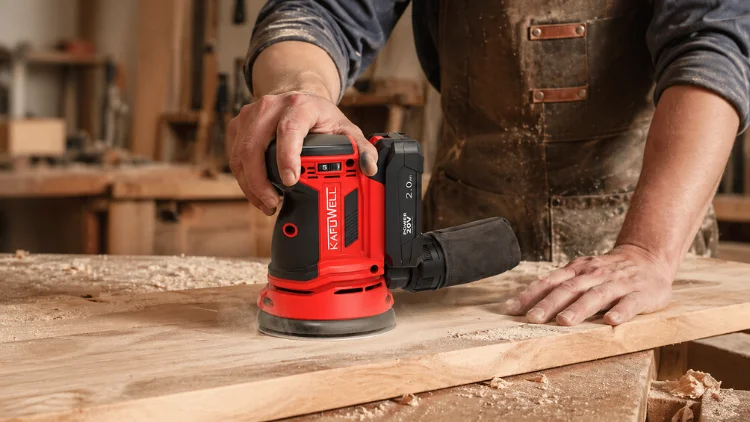
This is the orbital sander’s home territory. It handles flat panels, tabletops, cabinet doors, hardwood floors, and deck boards with equal ease. The random orbit pattern means you can sand across the grain without leaving visible marks — a critical advantage when working with wood.
Prepping Walls and Drywall Before Painting
Yes, you can use an orbital sander on drywall. It’s one of the fastest ways to smooth joint compound, knock down texture, or feather seams before painting. Use a vacuum attachment to manage the fine drywall dust, and stick to medium grit (100–120) to avoid cutting through the paper face of the drywall.
Removing Paint, Varnish, or Old Finish
When a surface needs stripping — peeling paint on a porch railing, old varnish on furniture, oxidized coating on metal — an orbital sander with coarse grit (40–60) removes material quickly without the aggressive bite of a belt sander. It’s aggressive enough to be efficient, but controlled enough to protect the base material.
Automotive Bodywork and Car Paint Prep
Orbital sanders are widely used in auto body shops for sanding primer, feathering paint edges, and preparing panels for repainting. A random orbital sander with a foam interface pad can even be used with wet sandpaper for ultra-fine finishing before buffing.
Finish Sanding Before Staining or Sealing
The final pass before applying stain, oil, or sealer is where the orbital sander really excels. Working up through grits (120 → 150 → 180 → 220) produces a surface that accepts finish evenly, without blotching or raised grain.
Read more: How to Use an Orbital Sander: A Beginner’s Guide
Orbital Sander vs. Belt Sander — Which Should You Choose?
Both are sanding tools, but they serve different purposes:
| Orbital Sander | Belt Sander | |
| Motion | Random elliptical | Straight, continuous loop |
| Aggression | Moderate | High |
| Finish quality | Smooth, swirl-free | Can leave directional scratches |
| Best for | Finishing, prep work, versatile use | Heavy stock removal, flattening rough lumber |
| Ease of use | Beginner-friendly | Requires more control |
| Risk of damage | Low | Higher — can gouge surfaces quickly |
If you need one sander for general use, the orbital sander wins every time. It’s safer, more forgiving, and produces a better finish on most materials. A belt sander is a specialist — reach for it only when you need to remove large amounts of material fast.
Frequently Asked Questions
Can You Use an Orbital Sander as a Polisher?
Yes — with the right pad. Swap the sandpaper for a foam polishing or buffing pad and you can use an orbital sander to apply wax, polish paint, or buff out light scratches. It won’t match the results of a dedicated dual-action (DA) car polisher, but it works well for light automotive detailing and furniture finishing.
Are Orbital Sander Pads Universal?
Not entirely. Most orbital sanders use a hook-and-loop (Velcro) system, which makes pad changes easy. However, you need to match the pad size to your sander — 5-inch pads on 5-inch sanders, 6-inch on 6-inch. Some brands use proprietary hole patterns for dust extraction, so always check compatibility before buying replacement pads or sandpaper.
What Is the Difference Between an Orbital Sander and a Random Orbital Sander?
In common usage, the terms are often used interchangeably — but technically, a standard orbital sander moves in a fixed circular pattern, while a random orbital sander adds an eccentric, unpredictable motion on top of that spin. Nearly all modern sanders sold today are random orbital, as the random motion produces a significantly better finish. When someone says “orbital sander,” they almost always mean the random orbital type.
How Often Should You Change Sandpaper on an Orbital Sander?
Change the sandpaper when it stops cutting efficiently — you’ll notice you have to press harder to get the same result, or the surface feels glazed rather than scratched. On average, a sheet of sandpaper lasts 10–15 minutes of active sanding on wood. Clogged paper not only slows you down; it also generates more heat, which can burn wood or damage finishes.
Conclusion
An orbital sander is one of the most practical, beginner-friendly power tools available — versatile enough for woodworking, drywall, automotive prep, and general finishing work. Its random orbit motion sets it apart from every other sanding tool by delivering a consistently smooth, swirl-free result with minimal risk of surface damage.
If you are looking for a reliable cordless orbital sander suitable for market distribution, the Kafuwell PA4235 20V Cordless Sander features hook-and-loop pad compatibility, variable speed control, and dust collection. It is well suited for both professional job sites and retail distribution channels. You can also view our product catalog to explore more Kafuwell power tools.