A power tool spec sheet usually packs a large number of figures into a small space — voltage, power, torque, speed — but these numbers aren’t always as straightforward as the marketing implies. Two drills with identical stated specs can perform very differently under load. This guide explains what these specifications mean.
Power Specifications
These describe the energy a tool draws or stores. They’re the first numbers a marketing team will push, and the most frequently manipulated.
Voltage (V). Nominal voltage is the rated working voltage of the motor or battery pack. For corded tools, this aligns with the local mains supply — typically 230 V at 50 Hz in EU markets and 120 V at 60 Hz in North American markets. The same motor will sometimes be specified differently across markets, so cross-market voltage comparisons can mislead. For cordless tools, you’ll see a nominal voltage (used in normal operation) and sometimes a “max voltage” that reflects a brief peak. A “20 V max” battery and an “18 V” battery are often the same pack measured two different ways. Common cordless platforms: 12 V, 18 V, 20 V max, 36 V, 40 V, 60 V.
Wattage (W). Power is where unit definitions get loose. Input wattage is what the tool draws from the wall. Output wattage is what the motor actually produces — typically 50–70% of input. Many corded tools list only input watts because that number looks larger. Range is wide: small drills sit around 500–800 W input, while large rotary hammers can exceed 1,500 W.
Amperage (A). Corded-tool spec sheets sometimes show current draw instead of, or alongside, wattage. A 10 A tool on 120 V draws roughly 1,200 W input.
Battery Capacity (Ah). Amp-hours measure how much energy a battery can deliver before needing a charge. Higher Ah means longer runtime but more weight and longer charge time. Cordless tool batteries typically range from 1.5 Ah on light platforms up to 12 Ah on heavy-duty packs.
Performance Specifications
These describe what the tool actually does — speed, force, impact. They’re where you compare across competing models.
Torque (Nm or in-lbs). Rotational force. Most relevant for drills, impact drivers, and impact wrenches. A solid cordless drill produces 50–100 Nm; a heavy-duty impact wrench can exceed 1,000 Nm. What’s being reported matters as much as the number itself — see the Red Flags section below.
RPM / No-Load Speed (NLS). Rotations per minute, measured with nothing attached. Most cordless drills have two speed ranges: a low gear around 0–500 RPM for high-torque driving, and a high gear around 0–1,800 RPM for drilling. Angle grinders run far higher — typically 8,000–11,000 RPM. RPM under actual load is always lower than the no-load number, sometimes significantly.
BPM (Blows Per Minute). Used for hammer drills and rotary hammers. A combi drill in hammer mode runs 20,000–30,000 BPM; an SDS rotary hammer runs lower (around 4,000–5,000 BPM) but with much higher impact energy per blow.
IPM (Impacts Per Minute). Used for impact drivers and impact wrenches. Most fall in the 3,000–4,000 IPM range.
Joule Rating (J). Impact energy per blow, used for rotary hammers and demolition hammers. Light SDS-plus units sit around 1.5–3 J; large SDS-max demolition tools reach 20 J and beyond. This number matters more than BPM when comparing rotary hammers for masonry work.
Physical & Build Specifications
These describe the tool’s body, attachment system, and durability against the environment.
Chuck or attachment size. Drill chucks come in 1/4″ hex (impact drivers), 3/8″ (light-duty drills), 1/2″ (standard cordless drills), and SDS-plus or SDS-max (rotary hammers). For angle grinders, disc diameter (100 / 115 / 125 / 180 / 230 mm) determines what cuts you can make.
Weight and dimensions. Important for sustained or overhead use. Weight excluding battery is the meaningful number for cordless tools.
Motor type. Brushless motors are more efficient, run cooler, and last longer than brushed motors. Most professional cordless tools released after 2020 are brushless. The spec sheet will say so explicitly when it is.
IP Rating. A two-digit code describing dust and water resistance. IPX4 covers light splash; IP54 adds dust protection; IP65 is dust-tight and resists low-pressure water jets. Important for outdoor or wet-environment use.
Bearings. Sealed ball bearings outlast bushings under heavy loads. Higher-end professional tools usually disclose bearing type; budget tools usually don’t.
Which Specs Matter Most by Tool Type
Not every spec is equally relevant to every tool. The table below shows where to focus when comparing models in the same category.
| Spec | Drills | Impact Drivers | Angle Grinders | Saws | Rotary Hammers |
| Voltage | Yes | Yes | Yes | Yes | Yes |
| Torque | Primary | Primary | |||
| RPM | Yes | Primary | Primary | Yes | |
| BPM | In hammer mode | Primary | |||
| IPM | Primary | ||||
| Joule rating | Primary | ||||
| Chuck or disc size | Yes | Yes | Yes | Yes | Yes |
If you’re comparing two cordless drills, voltage, torque, and chuck size are the deciding numbers. For two rotary hammers, the joule rating is more telling than the BPM.

Spec Sheet Red Flags
Most spec sheets are technically accurate but selectively presented. These are the patterns to watch for.
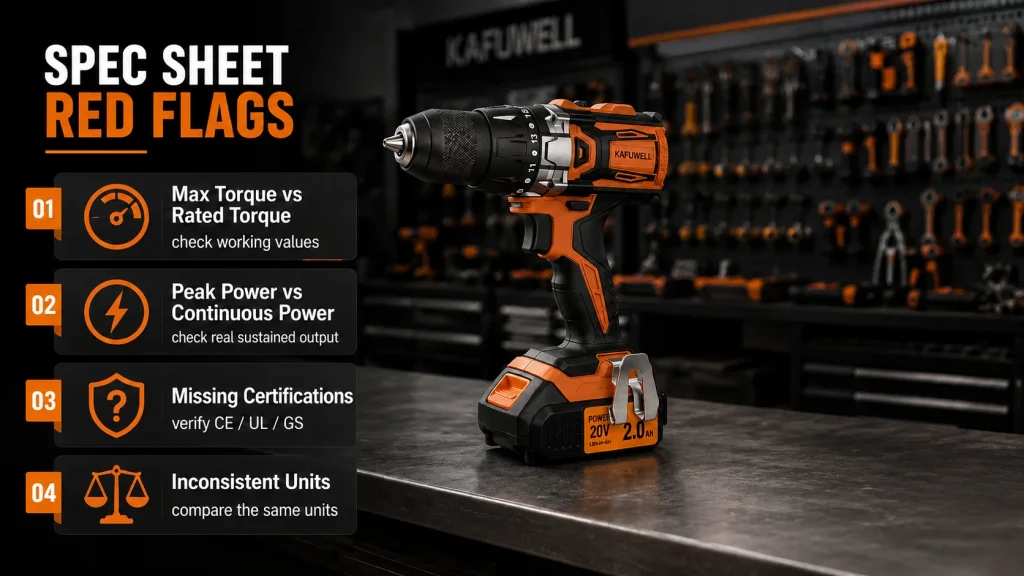
“Max torque” vs “rated torque.” Max torque is measured for a fraction of a second at stall — the peak number before the motor cuts out. Rated (or working) torque is what the tool delivers continuously. The difference can be 2–3x. If only “max” is listed, the working number is probably much lower.
“Peak power” vs “continuous power.” Same logic for wattage. Continuous output is what matters for sustained work; peak is a brief surge that lasts seconds.
“Up to” claims without test conditions. “Up to 4,500 IPM” without specifying load conditions tells you the maximum under ideal conditions, not what the tool does driving lag bolts into oak.
Missing certification info. A serious spec sheet states the certifications the model carries (CE, UL, GS, CCC, BS, SAA, EAC, depending on market). If the document doesn’t list any, treat it as a draft, not a final spec.
Inconsistent unit reporting. A spec sheet that mixes metric and imperial inconsistently — Nm in one row, in-lbs in the next, kg next to lbs — often signals a quickly translated document where conversion errors are likely. Cross-check the math before quoting it.
A clean spec sheet reports rated values, lists all relevant standards and certifications, sticks to consistent units, and matches its test conditions to real-world use. When you have that, you have something you can actually compare.
Summary
At KAFUWELL, we treat the clarity and comparability of spec data as part of the product. For our distributor and wholesale customers, we work to provide clear specifications on every tool — key rated values, applicable certifications, and consistent units — so you can evaluate performance and application fit accurately across the range.If you’re looking for a wholesale partner for power tools or hand tools, browse our range at kafuwell.com, or find detailed product and specification information under Catalog Download.