An angle grinder is one of the most commonly used and versatile power tools for contractors, metal fabricators, and serious DIY users. With the right grinding or cutting disc, it can handle a wide range of tasks, including cutting rebar, grinding concrete, removing rust, and polishing stainless steel surfaces.
This article will show you how to choose the right angle grinder based on the specific needs of your project.
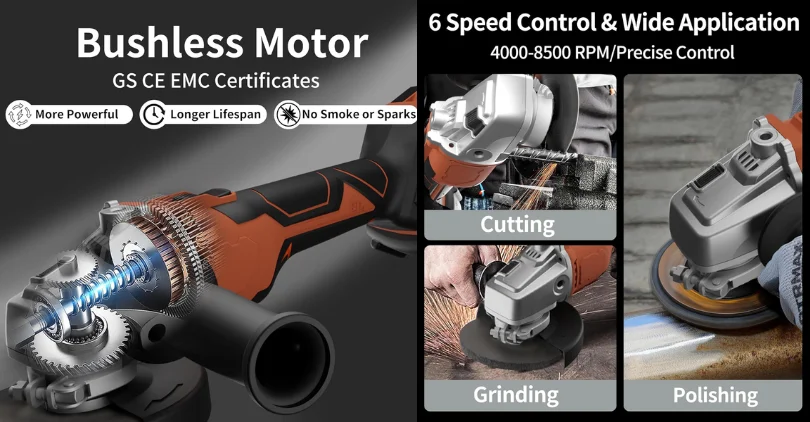
What Can an Angle Grinder Actually Do?
Before choosing a model, it helps to understand the full range of what angle grinders are built for. This ensures you are not buying a tool that is overkill — or one that will fall short.
Core Applications
• Cutting metal: pipes, rebar, angle iron, sheet steel
• Cutting concrete, stone, brick, and masonry (with diamond blades)
• Surface grinding: smoothing welds, deburring edges, shaping metal
• Rust and paint removal: using wire cup brushes or strip discs
• Polishing and finishing: stainless steel, stone surfaces, tile
• Tile cutting: making L-cuts and notches that wet saws cannot reach
When an Angle Grinder Is NOT the Right Tool
Angle grinders are aggressive, high-RPM tools. They are not suited for:
• Precision finish sanding on wood (use an orbital sander)
• Delicate material removal on soft surfaces
• Fine detail work requiring low vibration
Using the wrong tool for a task is the leading cause of disc failure and kickback incidents. Match the tool to the job before you start.
learn more: What is an Angle Grinder?
The 5 Key Factors to Choose the Right Angle Grinder
Every buying decision for an angle grinder comes down to five variables. Work through each one systematically and you will have a clear answer.
Factor 1 — Disc Size: Match the Size to Your Material
Disc size determines cutting depth, power requirements, and what materials you can realistically work with. It is the first specification to define.
| Disc Size | Best For | Max Cutting Depth | Typical User |
| 4–4.5 inch (100–115 mm) | Tile, thin metal, precision detail work | 1 1/8 inch | DIY, light fabrication |
| 5 inch (125 mm) | Metal cutting, grinding, deburring, most versatile | 1 1/2 inch | DIY to professional |
| 6 inch (150 mm) | Medium metalwork, thicker pipes | 2 inch | Trade professional |
| 7–9 inch (180–230 mm) | Concrete slabs, heavy steel, industrial cutting | 3+ inch | Construction, heavy industry |
Pro Tip: For most professionals who split time between metal work and occasional masonry, a 5-inch grinder is the most practical all-round investment. It covers 80% of jobs without the weight penalty of larger models.
Factor 2 — Power Source: Corded vs. Cordless
This decision comes down to one question: does your work demand mobility or sustained power output?
| Item | Corded | Cordless |
| Power delivery | Constant, never drops | May drop under heavy load |
| Runtime | Unlimited | Limited by battery charge |
| Best setting | Fixed workshop, fabrication shop | On-site, outdoor, multi-location |
| Maintenance | Lower | Battery replacement over time |
| Weight | Lighter (no battery) | Heavier (battery pack) |
| 2026 market trend | Standard for heavy-duty | Growing, 18V/20V now competitive |
If you run a fixed workshop and your grinder is in daily use for heavy cutting sessions, go corded. If your team moves between job sites and needs quick setup with no cord management, a quality 18V–20V brushless cordless model will handle most tasks efficiently.
Factor 3 — Motor Power and RPM
Two specifications define whether a grinder has enough muscle for your material:
Wattage (corded) / Voltage (cordless): This is raw motor power. Higher wattage means the motor maintains speed under load rather than bogging down.
| Power Range | Application |
| 500–750W (or 18V cordless) | Light tasks: trimming thin metal, tile work, DIY repairs |
| 750–1,000W | General professional use: metalwork, grinding, moderate cutting |
| 1,000–1,200W | Heavy cutting: thick steel, structural work |
| 1,200W+ (or 60V cordless) | Industrial: concrete, heavy fabrication, continuous heavy loads |
RPM (Revolutions Per Minute): Faster RPM produces cleaner cuts but also more heat. Most grinders operate between 8,000–12,000 RPM. Variable speed models (adjustable 2,800–12,000 RPM) give you control for both aggressive cutting and delicate polishing.
Never use a disc whose maximum RPM rating is lower than your grinder’s maximum speed. Doing so risks disc shattering at full RPM — a serious safety hazard.
Factor 4 — Safety Features
An angle grinder spinning at 10,000+ RPM is an inherently high-risk tool. Safety features are not optional extras — they are specifications that protect your operators and reduce liability on the job site.
Anti-restart protection
Prevents the grinder from auto-starting if power is restored after an outage. Critical for professional environments.
Soft start
Gradually ramps disc speed to prevent sudden torque jolts on startup — reduces disc stress and improves control.
Paddle switch (deadman switch)
Automatically cuts power when released. Preferred over slide switches for most professional applications.
Adjustable guard
Shields operators from sparks and disc fragments. Must be in place at all times during operation.
Brushless motor
Runs cooler, lasts up to 50% longer than brushed motors, and provides more consistent power delivery. Now standard in quality professional models.
Anti-kickback mechanism
Detects sudden disc bind and cuts motor power — prevents the violent kickback that causes most serious angle grinder injuries.
Factor 5 — Ergonomics and Weight
A grinder that fatigues your operators or is difficult to control is a productivity and safety problem. For extended use, ergonomics matter as much as raw specs.
Weight: Lighter models (1.5–2.5 kg) are easier to control for overhead or vertical work. Heavier models (3–5 kg) are more stable for sustained horizontal cutting.
Grip design: Look for textured, contoured grips that reduce vibration transfer to the hand.
Two-handle operation: A secondary side handle is non-negotiable for safe two-handed control.
Vibration control: Anti-vibration handles significantly reduce fatigue during extended sessions — especially important in construction and fabrication environments.
Choosing the Right Disc for the Job
Your grinder is the power unit. The disc defines the job. Using the wrong disc type is inefficient at best and dangerous at worst.
| Disc Type | Best Material | Key Specification |
| Metal cutting disc (thin) | Steel, iron, pipe, sheet metal | Match disc RPM to grinder max speed |
| Diamond cutting blade | Concrete, granite, marble, brick | Dry-cut or wet-cut rated |
| Grinding disc (depressed center) | Weld grinding, surface prep | Thickness affects aggressiveness |
| Flap disc | Metal finishing, light surface removal | Grit rating (40 = coarse, 120 = fine) |
| Wire cup brush / wheel | Rust removal, paint stripping, weld prep | Twisted vs. knotted wire |
| Strip disc | Paint, coatings, adhesive removal | Non-woven abrasive, gentle on base metal |
| Polishing pad | Stainless steel, stone finishing | Low RPM setting recommended |
Pro Tip: Never use a cutting disc for grinding or a grinding disc for cutting. Each disc is engineered for a specific load direction. Cross-use causes premature disc failure and kickback risk.
learn more: What Are Angle Grinders Used For?

Quick-Match Guide — Project Type to Grinder
Use this reference table to match your most common project type to the right grinder specification. For mixed-use environments, default to the highest-demand task as your baseline.
| Project Type | Disc Size | Power Range | Power Source | Key Feature |
| Home DIY / light repairs | 4–4.5 inch | 500–750W / 18V | Cordless | Lightweight, easy control |
| Metal fabrication / welding | 5–6 inch | 900–1,200W | Corded | Brushless motor, anti-kickback |
| Automotive repair | 4.5–5 inch | 750–1,000W | Either | Variable speed, paddle switch |
| Tile setting / masonry cuts | 4.5–5 inch | 750–1,000W | Cordless preferred | Diamond blade compatible |
| Concrete cutting / construction | 7–9 inch | 1,200W+ / 60V | Corded | High torque, adjustable guard |
| On-site / multi-location work | 4.5–5 inch | 18V–20V | Cordless | Battery platform compatibility |
Common Buying Mistakes to Avoid
Most poor angle grinder purchases come down to a handful of recurring errors. These are the ones we see most often in procurement decisions.
Mistake 1: Buying on Price Alone
A low-cost grinder may lack anti-kickback protection or have a brushed motor that burns out under sustained professional load. Total cost of ownership — including disc replacements, downtime, and repairs — almost always favors the mid-to-upper tier for regular professional use.
Mistake 2: Ignoring Disc Compatibility
Grinder size and disc size must match exactly. A 9-inch disc cannot be safely mounted on a 4.5-inch grinder, and attempting to do so is a documented cause of serious injury. Always verify the grinder’s maximum disc diameter before purchasing accessories.
Mistake 3: Choosing Cordless Without Checking Battery Ecosystem
Cordless grinders work best when they share a battery platform with your other tools. Buying a cordless grinder on a different voltage system than your drills and saws means additional batteries to manage, charge, and replace. Stick to one platform across your toolkit where possible.
Mistake 4: Underestimating Power Requirements for the Material
Thin metal does not tell you much about whether your grinder can handle concrete. If your workload includes occasional heavy masonry cuts, size up on power. A 750W model that bogs down constantly is less productive — and creates more heat stress on the disc — than a 1,200W model running at moderate load.
Mistake 5: Overlooking Safety Features for the Sake of Simplicity
Operators under time pressure skip safety checks. Tools with built-in protections like soft start and anti-kickback reduce the consequence of those moments. For team environments, these features are a risk management investment, not a luxury.
Conclusion
Choosing the right angle grinder is not a complicated process once you have a clear framework. The decision tree is straightforward:
• Start with your material and how thick it is — this sets your disc size.
• Define your work environment — this determines corded vs. cordless.
• Match your power rating to the most demanding task in your typical workload.
• Verify safety features meet the standards required for your team and site.
• Confirm disc compatibility before you buy a single accessory.
For most professional environments running mixed metal and occasional masonry work, a 5-inch corded brushless grinder in the 1,000–1,200W range is the practical baseline. From there, scale up for heavy concrete or structural steel, and supplement with a cordless model if your team works across multiple sites.
For businesses and professional users seeking dependable power tools, manufacturing quality and performance stability are critical. Kafuwell angle grinders are engineered for high-intensity and demanding working conditions, delivering stable power output and durable structural design to ensure efficient and smooth grinding and cutting every time.