Power tool distributors often focus too heavily on the lowest unit price for their first order, only to discover later that delayed delivery, high return rates, and unstable supply create hidden costs.
A better approach is to treat the first order as a real-world test of the manufacturer’s delivery capability and reliability, not just a routine restock.
1. Why the First Order Can Shape the Next Three Years
The first order does more than fill your warehouse. It reveals how the manufacturer actually performs in delivery timelines, quality control, communication, and after-sales support.
A supplier that attracts you with extremely low pricing but performs poorly in reliability can ultimately cost far more through refunds, negative reviews, and customer loss.
Instead of asking, “How cheaply can I buy this product?”, ask:
“If this partnership works well, would I be comfortable expanding business with this supplier over the next three years?”
This shift in thinking changes how you evaluate key factors:
- Delivery consistency
- Defect rate
- Response speed
- After-sales and warranty support
Price still matters, but it is only one part of the overall partnership.
2. Start With Your Own Positioning: Define the Partner You Actually Need
Before contacting any factory, clarify your business model.
Are you:
- A hardware retail store
- A power tool reseller
- A building materials supplier
- An e-commerce seller
- A regional wholesaler
Each model has different priorities. Physical retail stores may care more about product assortment and packaging quality, while e-commerce sellers often focus on carton dimensions, return rates, and listing-ready product images.
You must also decide whether profit margin or inventory turnover is your primary goal. Some distributors prioritize higher-margin, differentiated tools, while others focus on fast-moving, price-competitive SKUs.
Battery platform strategy is equally important. If you plan to build repeat sales around a unified 18V or 20V system, you need a manufacturer with a stable platform and a complete ecosystem of compatible tools.
These answers determine whether you should work with a large, specialized factory or a more flexible manufacturer offering broader coverage and OEM/ODM capabilities.
For example:
- If you are a small retail store with limited capital, prioritize manufacturers offering low MOQ, mixed-SKU shipments, and fast replenishment.
- If you are an established e-commerce seller building a private-label cordless tool line, prioritize manufacturers with mature 18V or 20V platforms and strong OEM/ODM capability, even if their MOQ is higher.
3. Initial Screening: Core Requirements Every Tool Manufacturer Must Meet
Once your positioning is clear, use these hard criteria to filter suppliers.
Factory Background and Certifications
Start with experience and credibility. How long have they been in the power tool industry? Which markets do they serve?
Manufacturers with experience in your target market better understand voltage standards, plug types, safety certifications, and user expectations.
Verify key certifications such as ISO quality management, and regional certifications like CE, GS, or UL, depending on your market.
Product Range and Platform System
Review their product lineup and platform strategy. Do they offer a unified cordless system, such as a 20V platform, where one battery works across multiple tools?
Check whether their product range covers your core categories, such as:
- Drills
- Impact drivers
- Angle grinders
- Circular saws
- Rotary hammers
- Sanders
- Outdoor power equipment
An incomplete product line is not conducive to building a stable sales assortment and achieving long-term growth.
MOQ and Lead Time
Minimum order quantity and production lead time are critical, especially for your first order.
Choose manufacturers that allow reasonable MOQs and mixed-SKU orders so you can test multiple products without excessive inventory risk.
Clarify production timelines for both initial and repeat orders, and ask about peak-season capacity. Factories without sufficient capacity may not support your growth.
If your primary customers are professional contractors, only work with manufacturers already supplying CE- or UL-compliant tools to similar markets.
If your customers are mainly DIY users, prioritize manufacturers with broad product coverage and stable lead times rather than highly specialized but limited suppliers.
Read more: Top 9 Power Tool Manufacturers in China
4. Look Beyond Unit Price: Understand Your True Cost
The ex-factory price is important, but it is only the starting point of your true cost calculation. Focusing only on the lowest unit price is one of the most common and most expensive mistakes distributors make.
To understand your real cost per unit, you should build a simple landed cost model. Start with the product cost, including any customization fees such as special packaging, color changes, or logo printing. Then add international freight, insurance, import duties, customs clearance fees, local transportation, and warehousing costs. These expenses can vary significantly depending on the country and the type of goods, especially when batteries or large tool cases are involved.
You must also consider the expected defect rate and return rate. A slightly cheaper tool with a higher failure rate can quickly erode your margins through refunds, replacements, and lost time. Be sure to include internal costs such as handling after-sales service, inspecting returned items, and managing negative reviews.
In addition, factor in marketing costs. If you sell online, you may need to invest in advertising and content creation. If you sell offline, you may need to budget for display materials or promotional campaigns.
Once you have all this data, you can compare suppliers based on their true sellable cost and profit margin instead of focusing only on the ex-factory price. That is the real basis for determining whether a partnership is truly profitable.
5. Samples and First Orders: What You Must Verify
Samples and the first order are your real-world performance test of a manufacturer. Treat them as a structured evaluation process, not a formality.
When evaluating samples, do more than check appearance. Test performance under load, verify torque and power, monitor overheating, and assess vibration and ergonomics.
For cordless tools, perform multiple charge and discharge cycles to evaluate battery stability.
Inspect packaging carefully:
- Is the manual clear and compliant?
- Are safety warnings properly included?
- Are accessories and cases secure?
After your first order arrives, track operational performance closely.
Compare promised lead time with actual delivery time. Record defect rates and shipping damage rates. Observe how quickly and effectively the supplier responds to issues.

6. After-Sales Support and Warranty: Essential for Customer Trust
Power tools operate under high load and contain motors and electronic components, so failures are inevitable. Strong after-sales support is essential.
Clarify warranty terms:
- Warranty duration
- What issues are covered
- Whether solutions involve repair, replacement, or compensation
Check spare parts availability. Can they supply switches, brushes, batteries, chargers, and housings? Do they provide technical drawings and service documentation?
Manufacturers offering spare parts and technical support provide significant long-term value.
7. Communication and Reliability: Core Indicators of Long-Term Partnership
A strong partner is defined not only by product quality but also by daily collaboration.
Evaluate their responsiveness. Do they reply quickly? Do they understand your market, or just send generic catalogs?
Assess flexibility. As your business grows, you may need custom colors, packaging, or bundle configurations. A good partner helps find practical solutions.
Reliability also means transparency. Professional manufacturers communicate early about delays or price changes, allowing you to adjust your plans.
If a supplier communicates proactively and consistently, they are a strong candidate for long-term partnership.
8. From Trial Order to Strategic Partnership: A Structured Approach
Move from trial orders to strategic partnership in phases.
Trial phase: Start with core SKUs such as drills and impact drivers to minimize risk.
Growth phase: Expand product range, add tool kits, additional models, and higher-capacity batteries.
Strategic phase: Negotiate volume discounts, annual agreements, or regional exclusivity.
9. Conclusion
Once you establish clear evaluation criteria, the next step is choosing a manufacturer that supports low-risk trial orders, stable supply, and scalable long-term growth.
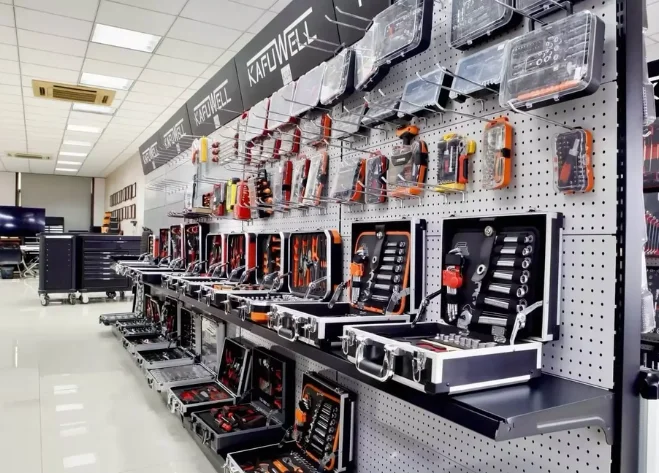
Kafuwell offers more than 4,000 in-stock SKUs with shipping available within 48 hours and tiered distributor discounts. We support low minimum order quantities, with carton-level ordering and mixed-SKU shipments, allowing you to test products while managing inventory risk.
Whether you are a distributor testing market demand or a contractor needing tools for construction and renovation projects, you can start small and scale confidently.You can also contact our team for tailored recommendations based on your business model, or download our product catalog to explore the full product range.