Yes. As long as you use the right blade and adjust your cutting technique to the metal’s thickness, a reciprocating saw can absolutely cut metal. It is a very practical tool for rough cuts, demolition work, and cutting in tight spaces, but it is not the best choice when you need perfectly clean or highly precise edges.

What Is a Reciprocating Saw and How Does It Cut?
A reciprocating saw cuts by moving the blade back and forth in a straight, linear motion. Unlike a circular saw that spins or an angle grinder that relies on abrasion, it removes material through direct tooth contact combined with stroke speed.
This cutting action makes it especially suitable for:
- Demolition and destructive work where precision is not critical
- Cutting metal that is already installed, such as pipes, conduit, brackets, and nails
- Working in confined spaces where larger tools cannot reach
What Types of Metal Can a Reciprocating Saw Cut?
A reciprocating saw can cut many common metals found on job sites or in DIY projects, including:
Thin sheet metal
A reciprocating saw can cut thin sheet metal (approximately 0.5–1.5 mm thick), but if the sheet is not clamped securely, it may grab or vibrate excessively. For thin sheet metal, using a finer-tooth blade helps reduce snagging.
Steel pipes and conduit
This is one of the most common applications. A reciprocating saw is well suited for cutting EMT conduit, steel pipe, and similar materials with a typical wall thickness of about 2–4 mm, as long as the pipe is properly secured.
Rebar and threaded rod
With the right blade, a reciprocating saw can easily cut rebar and threaded rod. It is an efficient option when a perfectly smooth cut is not required.
Aluminum and softer metals
Aluminum cuts more easily than steel, but the blade teeth can clog if the wrong blade is used or if you push too hard. Using a blade designed for metal significantly improves results.
Practical limits: thick or hardened steel
Thicker steel takes longer to cut and wears blades more quickly. Hardened steel is even more demanding. Once material thickness consistently exceeds about 5–6 mm, a reciprocating saw may still cut through, but efficiency drops noticeably, and other tools are often a better choice.
learn more: What Is a Reciprocating Saw Used For
What Blade Do You Need to Cut Metal?
When cutting metal, the blade matters more than the saw itself. In most cases, you will use one of the following:
Bi-metal blades
Bi-metal blades balance flexibility and durability and are the most common, cost-effective choice for metal cutting.
Carbide-tipped blades
Carbide-tipped blades typically last longer, especially when cutting harder metals or during demolition where mixed materials may be encountered. They cost more upfront but are often more economical when blades are replaced frequently.
Tooth count (TPI) for metal cutting
Tooth count is measured in TPI, or teeth per inch.
- Higher TPI generally produces smoother cuts and is better suited for thin metal
- Lower TPI cuts faster but is more likely to snag on thin material
A simple rule of thumb:
- Thin metal: higher TPI (typically 18–24 TPI)
- Thicker metal: mid-range TPI that still clears chips effectively (typically 14–18 TPI)
Blade length
The blade should be long enough that the shoe stays in contact with the workpiece throughout the cut. Longer is not always better, but a blade that is too short increases vibration and makes the cut harder to control.
For pipe and conduit work, 8–9 inch (about 200–230 mm) blades are a very common and stable choice.
How Thick of Metal Can a Reciprocating Saw Cut?
A reciprocating saw can cut fairly thick metal, but efficiency is the key consideration.
A practical guideline:
- Thin to medium metal (roughly ≤ 3–4 mm) usually cuts easily
- As thickness increases, cutting speed drops and blade wear increases
If you notice the following, you are likely beyond the ideal range:
- You have to apply significant pressure to keep the cut moving
- The blade heats up quickly and loses cutting effectiveness
- The cut takes so long that another tool would be faster and cleaner
How to Safely Cut Metal With a Reciprocating Saw
A reciprocating saw can be safe and controllable when used correctly, but metal cutting adds heat, vibration, and sharp edges. The following steps are critical.
Secure the workpiece firmly
Movement is the main cause of rough cuts and broken blades. Use clamps whenever possible. If clamping is not an option, brace the workpiece firmly against a solid surface.
Use the shoe correctly
Keep the saw’s shoe firmly pressed against the metal. This significantly reduces vibration and improves control.
Let the blade do the work
Apply steady pressure without forcing the cut. Excessive force overheats the blade, accelerates wear, and increases the risk of wandering cuts.
Control cutting speed
If your saw has variable speed, avoid running at maximum speed when cutting metal. This is especially important when cutting thicker material (around 3 mm and above), where slower, steadier cutting is more effective.
Watch heat and sparks
Metal cutting generates heat and sparks. Let the blade cool when necessary, and be aware of insulation, dust, or flammable materials nearby.
Wear basic protective gear
- Eye protection is essential
- Gloves help prevent cuts from sharp edges, but should fit snugly
- Metal cutting is loud, so hearing protection is recommended
- Long sleeves help protect against hot metal fragments
Reciprocating Saw vs Other Metal Cutting Tools
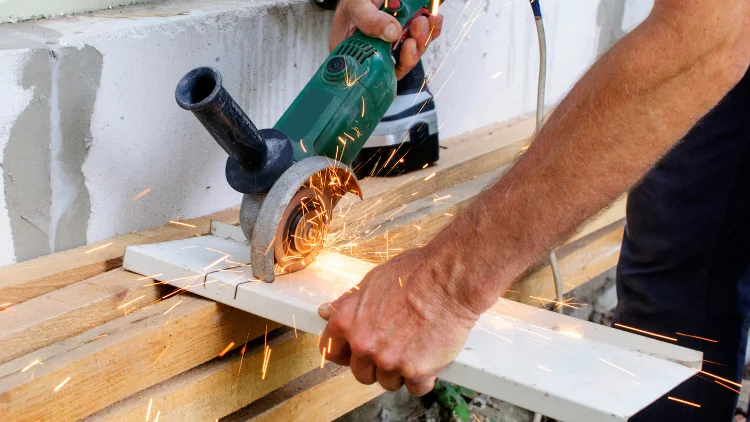
A reciprocating saw is not always the “best” tool, but it is often the most convenient.
Reciprocating saw vs angle grinder
- Angle grinder: faster cuts and cleaner edges, but more sparks and requires more working space
- Reciprocating saw: better for tight spaces and often safer in certain environments, though cuts are rougher
Reciprocating saw vs hacksaw
- Hacksaw: inexpensive, quiet, and precise with patience, but slow and physically demanding
- Reciprocating saw: much faster for repeated cuts
Reciprocating saw vs band saw
- Band saw: straighter, smoother cuts if the workpiece can be positioned properly
- Reciprocating saw: more portable and better for in-place cutting
For rough demolition work, a reciprocating saw is often ideal. For near-fabrication-quality cuts, a band saw, cut-off saw, or angle grinder is usually a better choice.
Common Problems and How to Fix Them
Excessive vibration
- Make sure the shoe stays in contact with the workpiece
- Try a longer blade if the saw is bouncing
- Secure the workpiece more firmly
Burned or dull blades
- Reduce speed and pressure
- For thicker steel (around 4 mm and above), use higher-quality blades
- Pause occasionally to allow the blade to cool
Crooked cuts
- Start with a shallow groove to guide the blade
- Keep the shoe planted and your grip steady
- Replace bent blades immediately
Slow cutting progress
- The TPI may be incorrect
- The blade may be worn out
- The metal may simply be thick enough to justify another tool
When Is a Reciprocating Saw the Right Tool for Metal?
A reciprocating saw is a strong choice when:
- You are doing demolition or remodeling work
- You are cutting metal in place, such as pipes, nails, brackets, or conduit
- Portability and flexibility matter more than cut appearance
- The cut will be hidden and does not need to look clean
Final Verdict
A reciprocating saw is one of the best power tools for cutting metal, especially in tight spaces or during demolition work, where it proves to be a very reliable option. Cutting performance mainly depends on three factors: safety, stability (vibration control), and starting the cut slowly. Mark the cut first, secure the workpiece, establish a shallow guide groove, then gradually increase speed for better results.