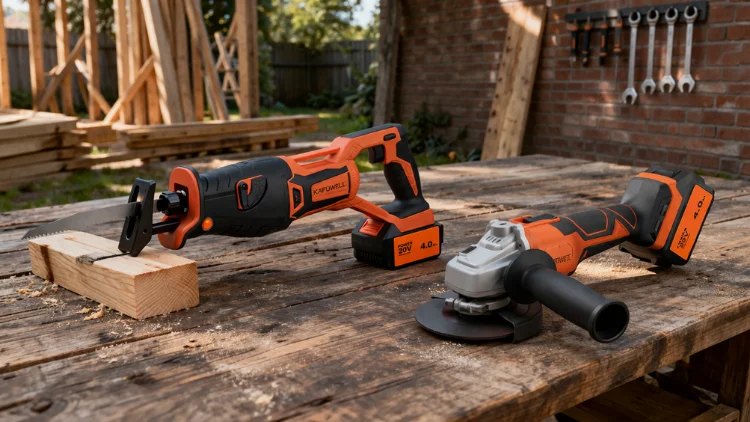
Both angle grinders and reciprocating saws can cut metal, but they rely on fundamentally different mechanisms. Choosing the wrong tool wastes time, wears through consumables faster, and may leave you with a poor-quality cut.
This guide compares both tools across speed, precision, blade selection, safety, and practical use cases—helping you match the right tool to the metal-cutting job ahead.
How Each Tool Cuts Metal
The core difference is mechanical. One spins an abrasive disc at thousands of revolutions per minute; the other drives a toothed blade back and forth in a linear stroke. That single distinction shapes everything from cut speed to edge finish quality.
Angle Grinder: Abrasive Disc Cutting
An angle grinder spins a thin abrasive disc at high speed—typically between 10,000 and 12,000 RPM on a standard 4.5-inch model. The disc has no teeth. Instead, millions of tiny abrasive grit particles on its edge grind through the metal, creating a narrow kerf and generating significant heat at the contact point.
Read more:What Is an Angle Grinder? Uses, Types, and Buying Guide
Reciprocating Saw: Toothed Blade Action
A reciprocating saw pushes a toothed blade in a linear back-and-forth motion, reaching up to 3,000 strokes per minute on most models. While thin-kerf metal reciprocating blades exist, they commonly produce a wider kerf than a thin cut-off wheel, generating noticeably less concentrated heat along the cut line.
Heat and Spark Behavior
Angle grinders, inherently possessing higher operational risks, produce substantial sparks that create significant fire hazards in hot work environments. Conversely, reciprocating saws generate far less thermal energy and minimal sparking, positioning them as a much lower-risk alternative where metal debris drops into a localized area directly below the immediate cut.
Cutting Speed: Where Each Tool Wins
For straight cuts through flat stock—mild steel plate, angle iron, or sheet metal—an angle grinder is widely considered faster. A high-speed thin abrasive disc generally requires less physical effort from the operator and slices through moderate-thickness steel in less time than a standard bi-metal reciprocating saw blade.
Reciprocating saws close the speed gap when the workpiece involves pipes, tubing, or irregular profiles where a rigid spinning disc cannot reach. For demolition tasks—removing old plumbing, rusted bolts, or welded metal frames—the reciprocating saw often proves more time-efficient because you spend less time repositioning the tool.
Precision and Cut Quality
Neither tool is engineered for precise machining tolerances, but they handle different metal-cutting situations with varying degrees of operator controllability and resulting edge finish. The nature of the cut—whether long straight runs on flat stock or angled work in tight corners—ultimately determines which tool delivers the better practical result.
Straight Cuts on Flat Stock
An angle grinder can produce a clean, relatively smooth edge when carefully guided along a marked line on flat material. The main challenge is control—the spinning disc tends to wander on longer cuts, and most grinders lack built-in depth adjustment. Thin materials may also warp from sustained heat concentration near the cut.
Cuts in Confined or Awkward Spaces
Reciprocating saws leave a rougher edge due to the toothed blade action, but they offer superior maneuverability in tight quarters. Variable speed triggers let you reduce the stroke rate for harder metals like stainless steel, which cuts vibration and extends blade life while maintaining reasonable control over the cut path.
Edge Finish and Secondary Work
For visible finish work, neither tool replaces a dedicated cold cut saw. Although standard demolition reciprocating blades leave a rough edge requiring secondary deburring, pairing thin metal with a higher 24-TPI blade can produce a fine finish with minimal burr. Meanwhile, grinders generally leave smoother edges on longer straight cuts.
Blade and Disc Selection
Choosing the right consumable for the metal type and thickness matters just as much as picking the tool itself. A mismatched disc or blade accelerates wear, generates excess heat, and degrades the ultimate quality of every single cut you make.
Angle Grinder Discs
Two disc types handle most metal-cutting jobs. Bonded abrasive cut-off wheels represent the default standard, while metal-rated diamond discs serve as the heavy-duty option offering significantly longer lifespans. Always verify any disc’s rated maximum RPM exceeds your grinder’s no-load speed to prevent dangerous shattering.
- Resin-bonded cut-off wheels — standard thin abrasive discs for slicing mild steel, rebar, and bolts.
- Metal-rated diamond discs — premium alternative designed to provide up to one hundred times longer cutting life.
Reciprocating Saw Blades
Two primary blade categories cover most metal-cutting tasks with reciprocating saws. In addition, remember that the teeth per inch rating directly controls how fast and how smoothly a specific blade penetrates different material thicknesses during the actual cutting process.
- Bi-metal blades — high-speed steel teeth bonded to a flexible body for general use.
- Carbide-tipped blades — aggressive and longer-lasting, built for thick metals and cast iron.
Side-by-Side Comparison
| Feature | Angle Grinder | Reciprocating Saw |
|---|---|---|
| Cutting motion | Rotary (abrasive disc) | Linear (toothed blade) |
| Typical speed | 10,000–12,000 RPM (4.5″) | Up to 3,000 SPM |
| Best for | Straight cuts, flat stock, grinding | Pipes, demolition, tight spaces |
| Cut finish | Smoother on straight cuts | Rougher, often needs deburring |
| Sparks / heat | High | Low |
| Control | Moderate (steady hand required) | Better in confined areas |
| Consumable cost | Varies by grade; bonded discs wear faster | Varies by grade; carbide blades last longer |
| Learning curve | Steeper (high safety risks per WorkSafe) | More forgiving for beginners |
Which Scenarios Favor Which Tool?
Choosing between these two tools often depends less on the type or grade of metal being cut and more on the physical shape of the workpiece, the access constraints around it, and the surrounding workspace conditions where the actual cutting will take place.
Workshop and Fabrication
In a shop environment where you make repeated straight cuts on steel bar, angle iron, or plate, the angle grinder is the natural first choice. It cuts flat surfaces faster and doubles as a grinding and deburring tool afterward, eliminating the need for a separate tool change between steps.
Read more:How to Choose the Right Angle Grinder for Your Next Project

Plumbing and Demolition
When cutting pipes inside walls, removing corroded ductwork, or dismantling welded structures on-site, a reciprocating saw handles the job with less hassle. Its blade accesses spaces a rigid grinder disc cannot reach, and the lower spark output measurably reduces fire risk in enclosed areas near insulation or accumulated dust.
Final Takeaway
In practical applications, tool selection not only affects cutting results but also directly impacts efficiency, safety, and overall costs. For professional buyers and distributors, consistent product quality and reliable supply are essential.
Kafuwell offers angle grinders, reciprocating saws, and a complete range of power tools suitable for metalworking, woodworking, and construction applications. Backed by a mature manufacturing system and stable quality, Kafuwell provides partners with more competitive product options. Visit https://www.kafuwell.com/download/ to access our product catalog.