For professional users or power tool distributors building a product line, cordless power tools are a significant investment. Before deciding to purchase a specific product, lifespan is one of the most practical and important questions to ask first.
The lifespan of cordless power tools depends on several factors. This article will explain the typical lifespan range, the key factors that affect service life, and the main reasons why it can vary.
Why Cordless Tool Lifespan Varies So Much
Most cordless power tools, under normal conditions, will last anywhere from two to twelve years. That is a wide range, and the gap between the low end and the high end comes down to three things: how often the tool is used, what it is used for, and how well it is maintained.
The table below provides a reliable reference point for lifespan expectations based on usage intensity.
| Usage Type | Frequency | Expected Tool Lifespan |
| Light DIY | 1 to 2 times per month | 8 to 12 years |
| Semi-professional | Weekly use | 4 to 7 years |
| Professional / Daily use | Daily, full shifts | 2 to 4 years |
These figures assume the tool is used for its intended application, stored properly, and given basic maintenance. A daily-use tool that is also misused, stored in a hot vehicle, and run on cheap off-brand batteries will fall well short of the two-year floor. Conversely, a light-duty DIY tool that is cleaned regularly and stored correctly can outlast these estimates with ease.
The single most important variable within any usage category is the motor type. Whether a tool uses a brushed or brushless motor has more impact on its expected lifespan than any other design decision. That distinction is worth understanding in detail before evaluating any cordless tool purchase.
Brushless vs. Brushed Motors: The Biggest Factor in Tool Lifespan
How a Brushed Motor Works and Why It Wears Out
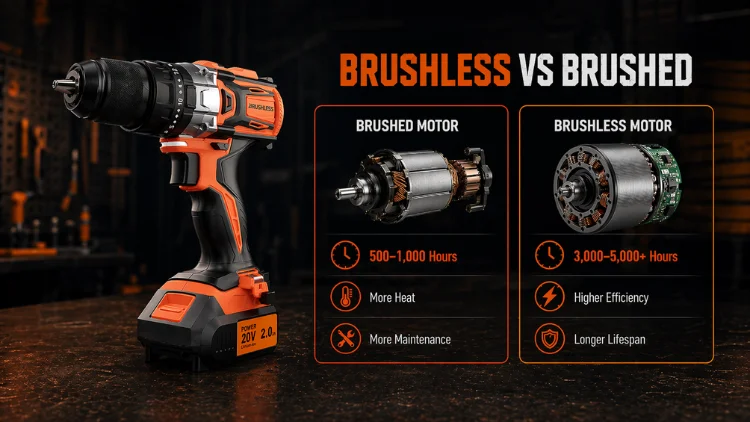
A brushed motor generates rotation through physical contact between carbon brushes and a rotating commutator. Every time the motor spins, the brushes press against the commutator surface. Friction is continuous and unavoidable. Over time, the carbon brushes wear down, the commutator surface becomes grooved, and performance degrades progressively until the motor fails.
Under normal use, a brushed motor in a cordless power tool will typically last between 500 and 1,000 operating hours. For a professional using a tool daily across full working shifts, that can translate to less than two years of service life. The signs of a brushed motor approaching the end of its life are visible sparking from the motor housing, unusual heat during operation, and a noticeable drop in power output.
Carbon brushes are a serviceable wear part, and replacing them can extend a brushed tool’s life. However, once the commutator itself is worn or the motor windings are damaged, repair is rarely cost-effective.
How a Brushless Motor Works and Why It Lasts Longer
A brushless motor eliminates the physical contact that causes wear in brushed designs. Instead of carbon brushes, an electronic controller manages the rotation of the motor by switching the current direction through the stator windings. The rotor spins without touching any stationary part of the motor assembly. Without friction, without wear particles, and without heat generated by mechanical contact, the motor operates more efficiently and degrades far more slowly.
Under normal use, a brushless motor will typically last between 3,000 and 5,000 operating hours. At the professional daily-use level, this represents a meaningful extension in service life. For distributors and procurement buyers, it also translates directly into lower total cost of ownership and fewer warranty claims per unit sold.
What This Difference Means in Real-World Use
The performance gap between brushed and brushless motors extends beyond lifespan alone. The table below summarizes the key differences that matter for purchasing decisions.
| Metric | Brushed Motor | Brushless Motor |
| Typical motor lifespan | 500 to 1,000 hours | 3,000 to 5,000+ hours |
| Energy efficiency | 75 to 80% | 85 to 90%+ |
| Heat generation | Higher | Lower |
| Maintenance requirement | Carbon brush replacement | Minimal |
| Unit cost | Lower | Higher |
| Total cost of ownership | Higher over time | Lower over time |
For a contractor running a cordless drill five days a week, the difference between a brushed and brushless motor is the difference between replacing a tool every two years and replacing it every five or six. For a distributor building a product line, it is the difference between managing frequent warranty returns and building a reputation for reliable product.
The brushless premium in upfront cost is real. The payback in reduced replacement frequency and lower after-sales burden is also real. For professional and semi-professional use, brushless is consistently the more economical choice over the full product lifecycle.
5 Other Factors That Determine How Long Your Tool Lasts
Motor type sets the ceiling on a tool’s potential lifespan. These five factors determine how close to that ceiling any given tool will actually get.
1. Battery Management
For many cordless tools, the battery reaches the end of its useful life before the motor does. Lithium-ion batteries degrade through a combination of charge cycles, heat exposure, and storage conditions. Budget-grade battery cells typically sustain 300 to 500 full charge cycles before capacity drops below 80 percent. Quality cells from reputable manufacturers sustain 800 to 1,000 cycles or more under the same conditions.
Three behaviors accelerate battery degradation faster than any other: repeatedly discharging the battery to zero percent before recharging, leaving the battery on the charger indefinitely after it reaches full charge, and exposing the battery to high heat during use or storage. Managing all three extends battery life significantly, which in turn extends the practical service life of the tool as a whole.
2. Application Match
Using the right tool for the job is the most consistently overlooked factor in tool lifespan. An 18V cordless drill running at full load for extended periods of concrete drilling it was not rated to handle will overheat its motor, stress its electronics, and wear its chuck far faster than the same tool used for its intended application of wood drilling and fastening.
Overloading a tool does not just accelerate the failure of the motor. It also stresses the battery management system, the gearbox, and the electronic speed controller simultaneously. The cumulative effect of chronic overuse shortens lifespan across multiple components at once. Matching the tool specification to the actual task is one of the simplest and most effective ways to protect the investment.
3. Storage Conditions
Temperature and humidity are the two environmental variables that most consistently shorten tool and battery life in storage. Heat accelerates the chemical degradation of lithium-ion cells, causes plastic components to become brittle, and promotes corrosion in motor contacts and electronic components. Direct sunlight in a vehicle or workshop compounds the effect. A tool left regularly in the back of a truck during summer months in a hot climate is aging even when it is not being used.
Ideal storage conditions are a dry environment at 15 to 25 degrees Celsius, away from direct sunlight and moisture. Batteries in long-term storage should be kept at 40 to 60 percent charge rather than fully charged or fully discharged.
4. Maintenance Habits
Cordless tools are frequently sold on the basis that they require minimal maintenance, which is true relative to pneumatic or gasoline-powered tools. However, minimal maintenance is not the same as no maintenance. Dust and debris accumulating in motor ventilation slots reduce airflow and cause the motor to run hotter. Chuck mechanisms and blade attachment points that are not periodically inspected develop play that affects precision and puts additional stress on the motor during operation.
Basic cleaning after use, periodic inspection of high-wear contact points, and removing batteries before extended storage periods are habits that cost almost no time but have a measurable impact on how long a tool remains in reliable working condition.
5. Build Quality and Component Grade
Two cordless drills with identical voltage, torque, and speed specifications on the box can have very different internal component grades. Professional-grade tools use higher-quality copper windings, more robust gear materials, better-sealed bearings, and more sophisticated electronic controllers. The external specifications do not always reflect these differences, but the service life does.
For distributors, this is a critical factor when evaluating suppliers. Requesting detailed component specifications, reviewing the manufacturer’s quality certifications, and examining warranty terms are more reliable indicators of actual build quality than nominal performance figures alone.
How to Make Your Cordless Tools Last Longer and What to Avoid
Best Practices
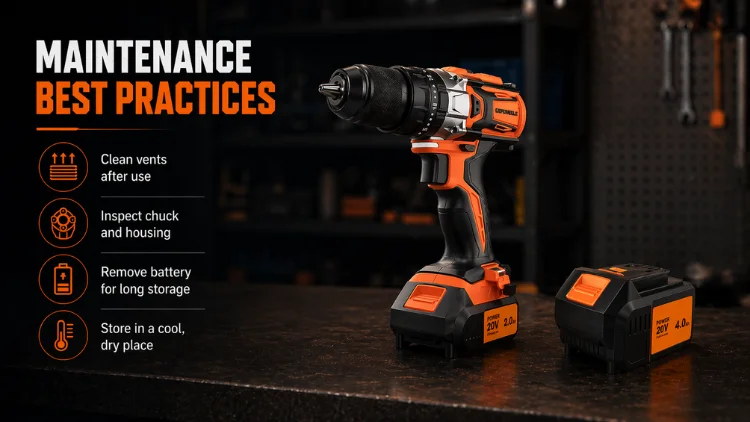
After each use, clear debris from ventilation slots using compressed air or a soft brush. If the tool will not be used for more than a few weeks, remove the battery and store it separately at partial charge.
Every three months, inspect the chuck or blade attachment point for unusual play, check the switch for smooth operation, and examine the housing for cracks or impact damage that could allow moisture or dust ingress.
For battery care, avoid leaving the battery connected to the charger after it has reached full charge. Store batteries at 40 to 60 percent charge in a cool, dry location. In cold climates, allow batteries to warm to room temperature before use, as lithium-ion cells lose capacity temporarily in low temperatures and forcing high-current discharge in cold conditions accelerates permanent degradation.
For repairs, carbon brushes and battery packs are worth replacing when they show signs of wear. Switches and chucks on professional-grade tools are also worth servicing. Motor windings and electronic speed controllers are generally not worth repairing on mid-range tools, as the repair cost approaches or exceeds replacement cost.
Common Mistakes That Shorten Tool Lifespan
Running the battery to zero percent repeatedly before recharging is the single most common mistake that shortens battery life prematurely. Lithium-ion chemistry performs best when kept between 20 and 80 percent charge in regular use.
Leaving tools in vehicles during hot weather exposes both the motor and the battery to temperatures that can cause permanent damage even when the tool is not in use.
Forcing a tool to perform tasks it was not designed for, whether using a cordless drill as a substitute for a rotary hammer on concrete or running a jigsaw at full speed through material that exceeds its rated capacity, produces overload stress that accumulates across multiple components simultaneously.
Ignoring early warning signs, specifically unusual heat during normal operation, unfamiliar smells from the motor housing, or noticeable drops in power output, allows minor issues to develop into failures that require full tool replacement rather than simple repair.
Using low-quality replacement batteries from unknown manufacturers is a risk that extends beyond battery life. Batteries without proper battery management circuits can deliver unregulated current that damages the tool’s electronic controller, creating a failure mode that is neither covered by warranty nor inexpensive to repair.
Frequently Asked Questions
How Long Does a Cordless Drill Last?
Under light to moderate DIY use, a quality cordless drill will typically last 8 to 12 years. Under professional daily use, expect 2 to 4 years before performance degrades to the point of replacement. These figures assume appropriate application, correct storage, and basic maintenance.
Do Brushless Motors Ever Need to Be Replaced?
Brushless motors do not have wear parts in the same way brushed motors do. In practice, a brushless motor in a well-built tool will outlast the battery, the chuck, and often the tool housing before the motor itself fails. In most cases, a brushless cordless tool that stops working has failed at the battery, the electronic controller, or a mechanical component rather than the motor itself.
Is It Worth Repairing a Cordless Tool or Buying a New One?
The answer depends on the tool’s original cost and the nature of the failure. Replacing a battery pack or a set of carbon brushes on a tool that otherwise functions well is almost always worth doing. Repairing a motor or electronic speed controller on a mid-range tool typically is not, as parts and labor costs approach the price of a replacement. On professional-grade tools with a higher original investment, motor and controller repair can be justified if the manufacturer provides service documentation and spare parts.
Does a Brushless Tool Really Last Longer Than a Brushed One in Daily Use?
Yes, consistently and significantly. The operating hour difference between brushed and brushless motors, 500 to 1,000 hours versus 3,000 to 5,000 hours, reflects a fundamental difference in how the motor generates rotation rather than a marginal improvement in component quality. For users running tools under sustained daily load, brushless motors represent a genuine and measurable improvement in service life, not a marketing distinction.
Conclusion
The lifespan of a cordless power tool is not fixed at the point of manufacture. Motor type sets the potential, but usage habits, battery management, storage conditions, and build quality determine whether a tool reaches that potential or falls well short of it.
For distributors evaluating product lines, the practical implication is clear. A brushless tool with a higher unit cost and a longer service life consistently delivers better value to the end customer than a cheaper brushed alternative that requires replacement twice as often. Lower warranty return rates, stronger customer retention, and a more defensible price position in the market all follow from sourcing tools built to last.KAFUWELL’s 20V brushless cordless platform is designed for distributors who need reliable performance across high-volume, multi-SKU product assortments. All brushless models in this range come with a one-year warranty, and the entire 20V platform uses interchangeable batteries, allowing end customers to expand their tool collection without replacing their existing battery inventory. You can download the product catalog to view the full brushless range, or contact our team directly to learn about the power tool wholesale solutions available for your market.