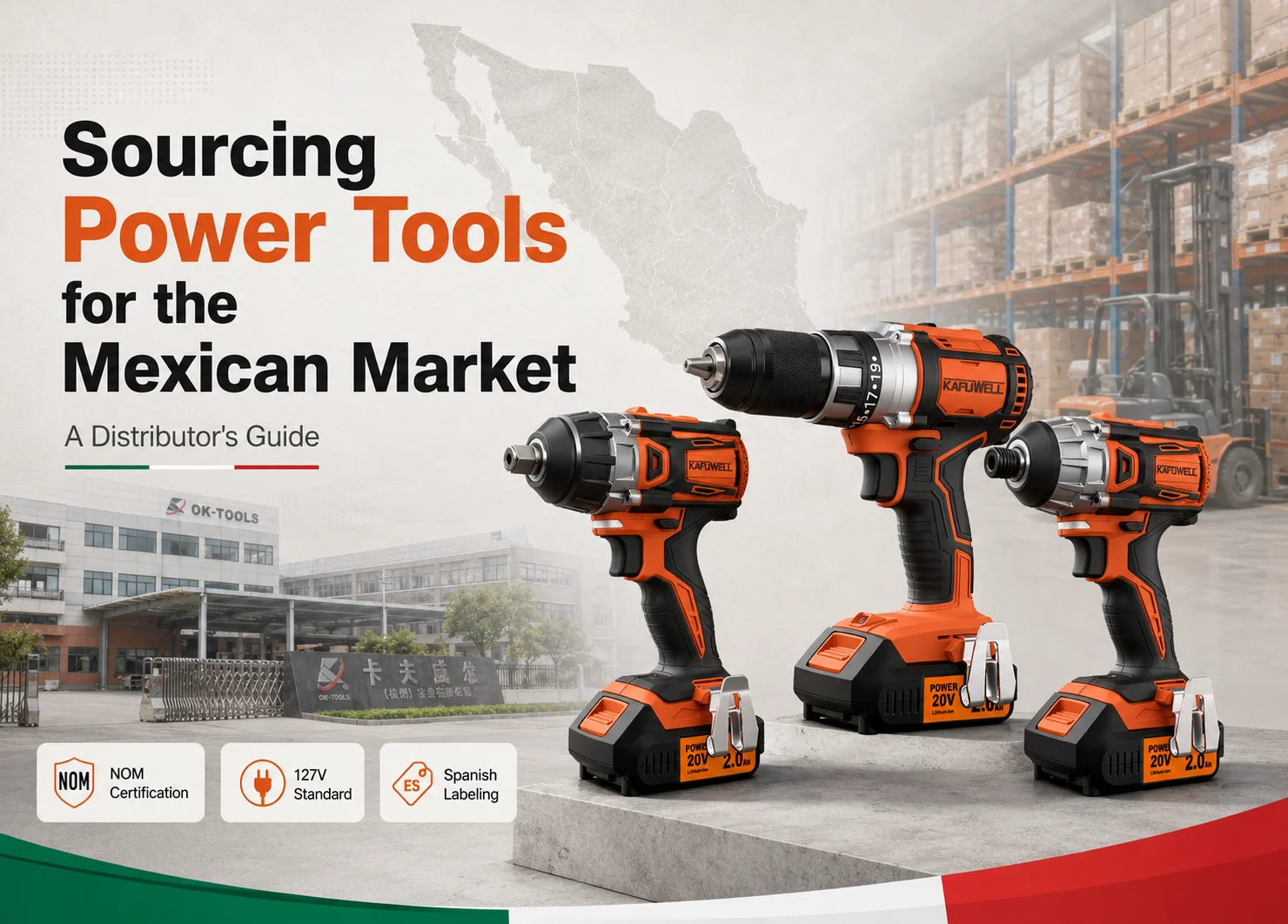
Bulk purchasing power tools is often a critical business decision. Most distributors know that well-known brands come with premium pricing, and costs rise quickly when you buy at scale. On the other hand, choosing cheap no-name tools can lead to unstable quality, jobsite downtime, and costly returns, which often ends up being far more expensive in the long run.
In this guide, we’ll cover the most common problems distributors face when wholesaling power tools, and the key advantages of partnering directly with a power tool manufacturer.

Common Pain Points for Power Tool Distributors
Pricing Transparency
Many distributors have received significantly different quotations for the same specifications. In many cases, the differences are not caused by configuration or quality, but by the number of layers in the supply chain.
From factory to market, products often pass through trading companies and agents. By the time the product reaches you, your profit margin has already been squeezed.
Supply Stability
Power tools typically have seasonal demand. During peak construction periods or when multiple projects launch at the same time, replenishment speed becomes crucial. Under traditional sourcing models, distributors often cannot see real inventory or production schedules, which makes it difficult to control restocking cycles.
Once stockouts happen in peak season, the damage is not limited to lost orders. It also affects how customers judge your reliability as a supplier.
Information Access
When distributors do not work directly with manufacturers, they often miss first-hand information. New product launches, feature upgrades, model iterations, and accessory updates may already be available in the market before you even hear about them from upstream channels.
This delays your go-to-market timing and causes you to miss the best window for product launches and promotions.
After-Sales Execution
Many distributors focus on warranty length when purchasing. In real operations, however, what matters more is whether spare parts are available and whether repair lead time is predictable.
For construction customers, a broken tool can mean downtime, and downtime losses are often far higher than the tool’s purchase price. By working directly with a power tool manufacturer, distributors can get faster access to spare parts and technical repair support.
Benefits of Buying Directly from a Power Tool Manufacturer
Lower Cost
Working directly with a power tool manufacturer reduces middle-layer markups. This gives distributors more room for profit and makes it easier to access preferential pricing policies.
For example, Kafuwell can offer professional-grade quality at prices roughly 30% lower than major brands. Discount tiers and rebate programs are also available based on annual purchase volume.
Lead Time Control
Manufacturers typically have stronger inventory resources. Once you connect directly with the factory, you can better manage supply rhythm. Even if you suddenly face a large demand spike or a major order, you are more likely to secure fast fulfillment.
Quality Control
Another core value of working directly with a power tool manufacturer is controllable quality. Distributors can request a clear QC system, such as incoming inspection, in-process inspection, outgoing inspection, and sampling standards. You can also verify whether compliance certifications are complete.
For example, KAFUWELL holds certifications including ISO, CE, BSCI, and RoHS. Its products meet international standards and can support compliant delivery in different markets.
Faster After-Sales and Spare Parts Response
Manufacturers usually provide technical training (remote or on-site), including common fault diagnosis, replacement of wear parts, tool maintenance, and best practices for battery platform usage.
Distributors can keep a basic spare parts kit locally, allowing common issues to be diagnosed and resolved quickly. For complex cases, the manufacturer can provide technical support or a return-to-factory solution. With clearly defined responsibilities and service timelines, after-sales support becomes truly manageable.
Broader Product Range
A complete product line covers more jobsite and application scenarios, which helps distributors build a stable supply system around a single battery platform.
Once customers choose a battery and charger platform, they can continue expanding to more tools within the same ecosystem. This lowers compatibility issues and reduces maintenance costs. A platform-based ecosystem also supports bundle strategies and scenario-based kits, improving average order value and repeat purchase rate.
To quickly review Kafuwell’s full product range, visit our catalog download page.
Marketing Support
Mature power tool manufacturers do more than supply products. They often provide marketing resources such as e-catalogs, product images, training documents, display materials, merchandising suggestions, and in some key markets, co-marketing or trade show support.
With these resources, distributors can launch faster and improve sales efficiency.
Product Selection Guidance
Many tool complaints are not caused by poor quality, but by mismatched product selection. For example, using an entry-level model for high-intensity jobsite work, or choosing insufficient battery capacity that forces frequent charging, can lead to dissatisfaction and returns.
Manufacturers can provide professional selection guidance: recommending power, torque, speed, battery platform, and accessory combinations based on actual use cases. This reduces mis-purchases, lowers after-sales costs for distributors, and helps maintain a stronger reputation.
OEM/ODM Support
Working directly with a manufacturer allows you to turn market needs into executable products and delivery plans much faster. Common customization typically falls into four areas: branding (appearance, color options, logo, and packaging), localization (manual and label language, barcodes, and compliance information), bundle configurations (tool body/battery/charger/accessory combinations and version options), and market-specific compliance alignment.
For distributors, customization is not just about aesthetics. It helps you create differentiated SKUs and channel-exclusive models, reducing direct price comparison and improving margin control.

How to Start a Power Tool Wholesale Partnership with Kafuwell
You can visit https://www.kafuwell.com and submit an inquiry via the “Contact Us” form. Share details such as your country/market, target product categories, and estimated first-order volume. We will respond quickly, answer your questions, and provide practical solutions. On-site visits are also welcome.
We offer a one-stop service. From product selection, quotation, and policy confirmation, to samples or trial orders, packaging and label localization, quality inspection standards, shipping and export documents, and spare parts plus after-sales process support, one dedicated team will manage the entire workflow. This helps distributors launch faster and reduce communication costs.
We also support a flexible MOQ: one carton minimum, with mixed models allowed. This gives you maximum purchasing flexibility, makes it easier to test products and the market, and is also suitable for customers who need small quantities for construction sites or renovation projects.
Read more: Why Distributors Should Choose Chinese Tool Manufacturers in 2025